Executive Summary
A global automotive supplier operating a mid-sized manufacturing facility faced a severe operational crisis, with
production instability, inventory imbalance, and risk of supply disruption across multiple product lines supplying
a global OEM manufacturing facility. What initially appeared as isolated operational issues was, in reality, a
systemic breakdown across production, supply chain, and leadership.
Through a structured operational turnaround, the organization stabilized operations, restored control systems,
and significantly improved performance.
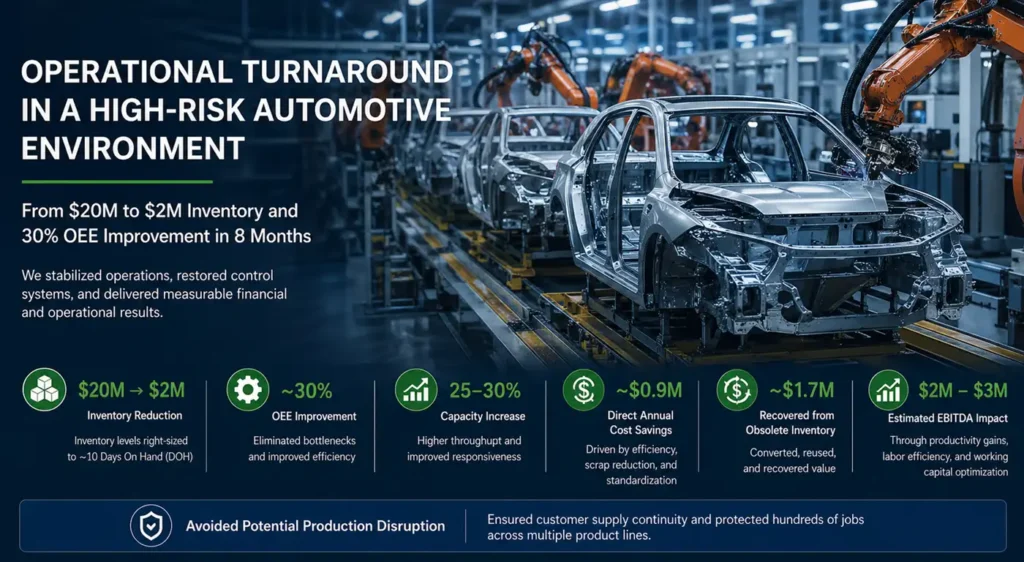
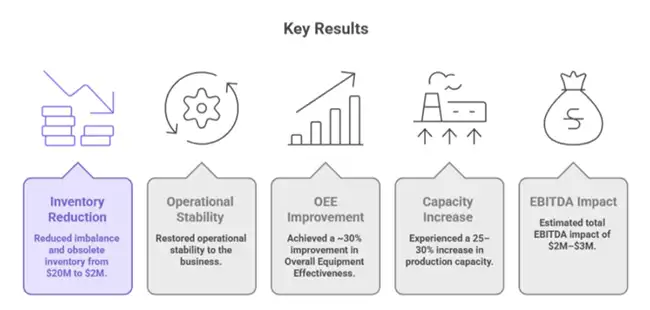
Key results included reducing imbalance and obsolete inventory from approximately $20M to $2M—bringing
inventory to approximately 10 Days On Hand (DOH) and restoring operational stability—alongside a ~30%
improvement in OEE, a 25–30% increase in capacity, approximately $0.9M in direct annual savings, and an
estimated total EBITDA impact of $2M–$3M.
Client Overview
- Global automotive OEM facility (confidential client)
- Affected by a global supplier with a local manufacturing site (approximately 600 employees)
- Unique parts manufactured
- High-complexity production environment with significant product variability
The Situation: A System Under Stress
The supplier facility was facing a critical operational breakdown, with escalating instability across production, supply chain, and leadership—placing deliveries at risk of disruption. Production bottlenecks, elevated scrap rates, long lead times, and recurring quality issues were impacting overall performance.
Inventory levels were severely misaligned, with approximately $20M in stock compared to an estimated requirement of $2M. Much of this inventory was either obsolete or unusable due to frequent design changes.
External pressures further intensified the situation. Supply chain disruptions, import restrictions, and frequent changes in production mix created a highly volatile environment, limiting the plant’s ability to respond effectively.
At its peak, the operation even generated production stoppages affecting multiple product lines and hundreds of employees at customer.
The Challenge: Complexity Beyond Operations
The challenge extended beyond operational inefficiencies. Leadership instability, organizational misalignment, and labor dynamics added layers of complexity. Multiple plant leadership changes and union-related challenges created an environment where execution required not only technical solutions but also strong stakeholder alignment and accountability, which were lacking.
The turnaround required simultaneous action across production, supply chain, inventory, and organizational systems—all under time pressure and with limited margin for error.
The Approach: Structured Operational Turnaround
Inventory Stabilization and Working Capital Optimization
A dynamic inventory model was implemented, targeting approximately 10 Days On Hand (DOH). This approach enabled the organization to rebalance inventory according to production mix, demand variability and components lead time required. Obsolete materials were analyzed and partially recovered through conversion and reuse strategies.
Capacity and Throughput Improvement
Critical bottlenecks were identified and addressed, including key constraints in quality control processes. Production scheduling was optimized, and additional shifts were introduced to stabilize throughput and improve responsiveness. This eliminated a critical constraint in the production flow, directly enabling the step-change improvement in OEE and throughput.
Control Systems and Visibility
A structured performance management system was implemented, including dashboards and KPIs such as OEE and First Time Through (FTT). These tools provided real-time visibility into line performance and enabled data-driven decision-making.
Organizational Alignment and Execution Discipline
Cross-functional collaboration was strengthened across engineering, operations, and supply chain teams. Training and management routines were introduced to ensure consistency, accountability, and sustained execution.
Key Transformation Example: Quality Check Bottleneck
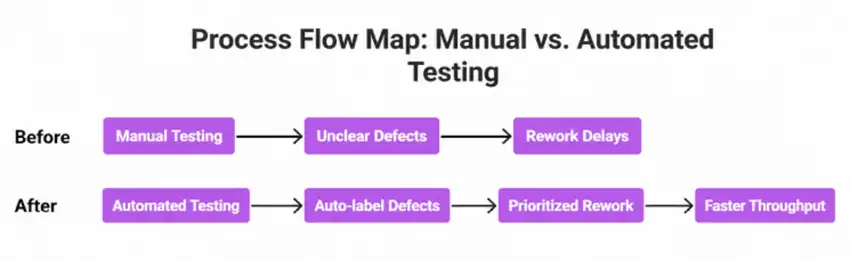
A major constraint was identified in the quality-check process, where all products were manually tested. This created delays and inefficient rework cycles due to limited visibility of defects.
The process was redesigned to include automated labeling of defects, enabling operators to quickly identify and prioritize corrective actions. This improvement significantly reduced rework inefficiencies and contributed to a substantial increase in throughput.
This initiative was a key driver of the overall ~30% improvement in OEE.
Results Achieved
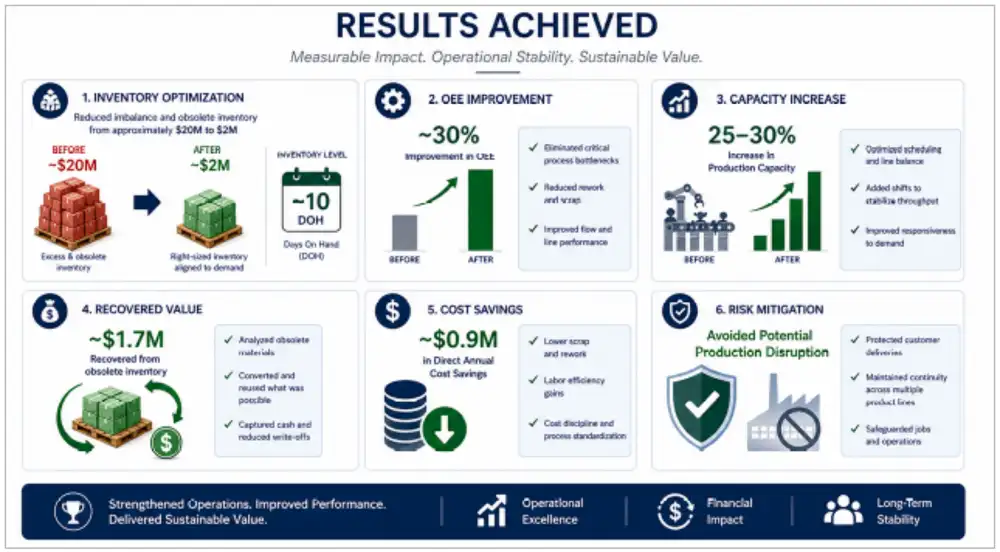
- Reduction of imbalance and obsolete inventory from approximately $20M to $2M, resulting in inventory levels aligned to approximately 10 DOH
- ~30% improvement in OEE
- 25–30% increase in production capacity
- ~$1.7M recovered from obsolete inventory
- ~$0.9M in direct annual cost savings
- Avoided potential production disruption
Financial Impact
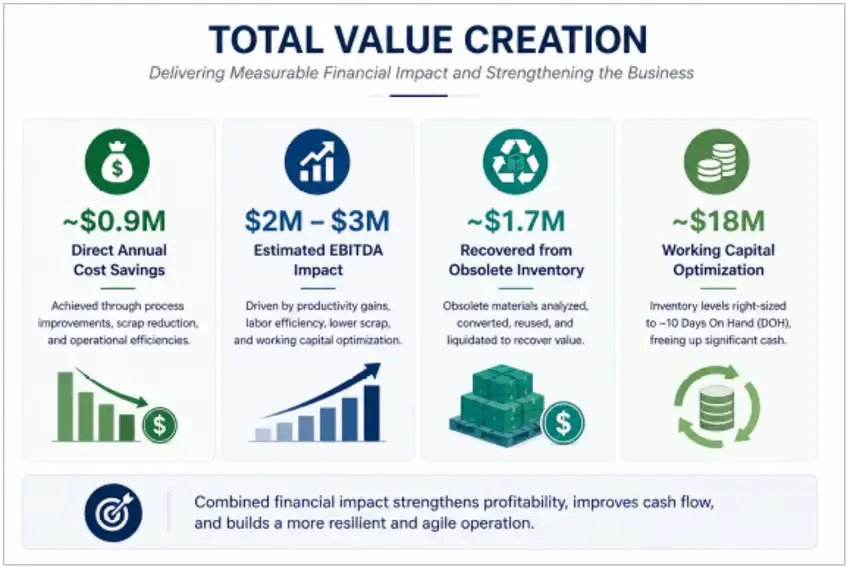
The project delivered approximately $0.9M in direct annual savings. When factoring in productivity gains, labor efficiency, scrap reduction, and working capital optimization, the total EBITDA impact is estimated between $2M and $3M. This also represented approximately $18M in working capital optimization through inventory normalization.
Additionally, the initiative mitigated the risk of customer production disruption, representing significant strategic value.
Total Value Creation
- ~$0.9M in direct annual cost savings
- $2M–$3M estimated EBITDA impact
- ~$1.7M recovered from obsolete inventory
- ~$18M working capital optimization
Sustainability
The improvements were sustained through structured management routines, performance dashboards, and clear KPI ownership, ensuring ongoing visibility and accountability across the organization.
Key Success Factors
- Reestablishment of a clear and consistent QOS (Quality Operating System)
- Data-driven decision making
- Root-cause-driven problem solving
- Re-establishing operational discipline in a highly unstable environment
- Aligning leadership and workforce behavior around clear performance metrics
Conclusion
This case demonstrates how a structured operational turnaround can stabilize complex manufacturing environments, unlock significant value, and mitigate operational risk under high-pressure conditions.
Next Steps for Executive Consideration
For executives evaluating how to improve cost structure, operational performance, cash flow, and long-term competitiveness, a structured Operational Excellence strategy can be a powerful value creation lever.
To learn more about AM Saxum’s Operational Excellence, Lean Six Sigma, and Lean Leadership advisory services—or to discuss your organization’s specific priorities—contact AM Saxum at 1-888-772-2809 or visit: