Executive Summary
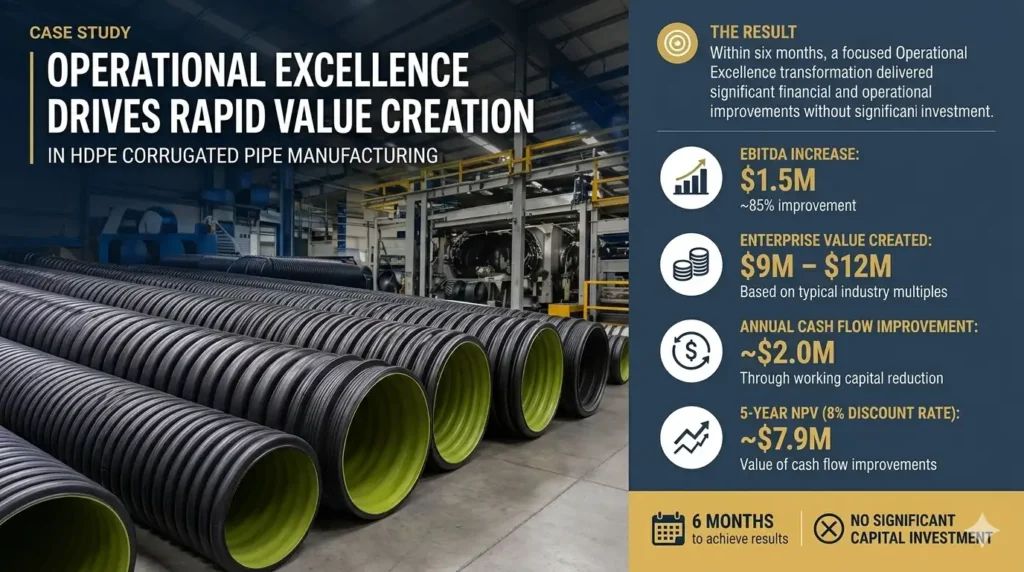
A global manufacturing group, previously backed by a private equity firm, faced operational inefficiencies in a strategically important plant. Within six months, a targeted Operational Excellence transformation delivered a ~$1.5M EBITDA increase, expanded margins from 12.4% to 21.7%, improved cash flow through working capital reduction, and enhanced operational performance without significant capital investment.
Investment Context
The company operated a multinational footprint with several production facilities. One plant was underperforming despite its strategic importance. Key challenges included high overtime labor costs, poor product quality, excess inventory, slow receivables, and inefficient production processes.
Value Creation Opportunity
Prior to the transformation, the plant exhibited low EBITDA margins (~12%), high working capital requirements, frequent production bottlenecks, and inconsistent delivery performance, limiting its ability to meet demand.
Transformation Approach
A focused Operational Excellence program was implemented targeting production efficiency, quality improvement, working capital optimization, and governance. Lean tools such as SMED, 5S, Kanban, and root cause analysis were applied to address key inefficiencies.
The transformation was executed in an environment with limited initial data availability, requiring rapid data collection and validation to support decision-making and ensure financial impact was accurately captured.
Operational Improvements
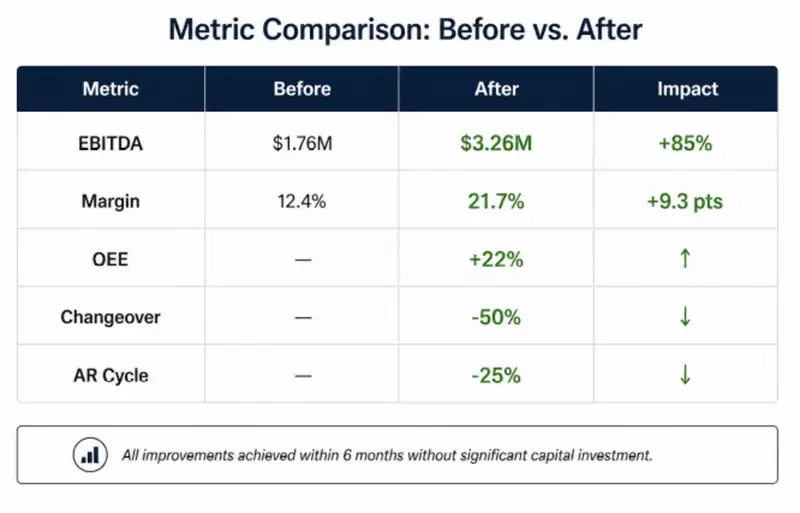
- 22% increase in OEE
- 50% reduction in changeover time
- Significant scrap reduction through root cause analysis
- 25% reduction in receivables cycle time
- Improved on-time delivery and throughput
Financial Impact
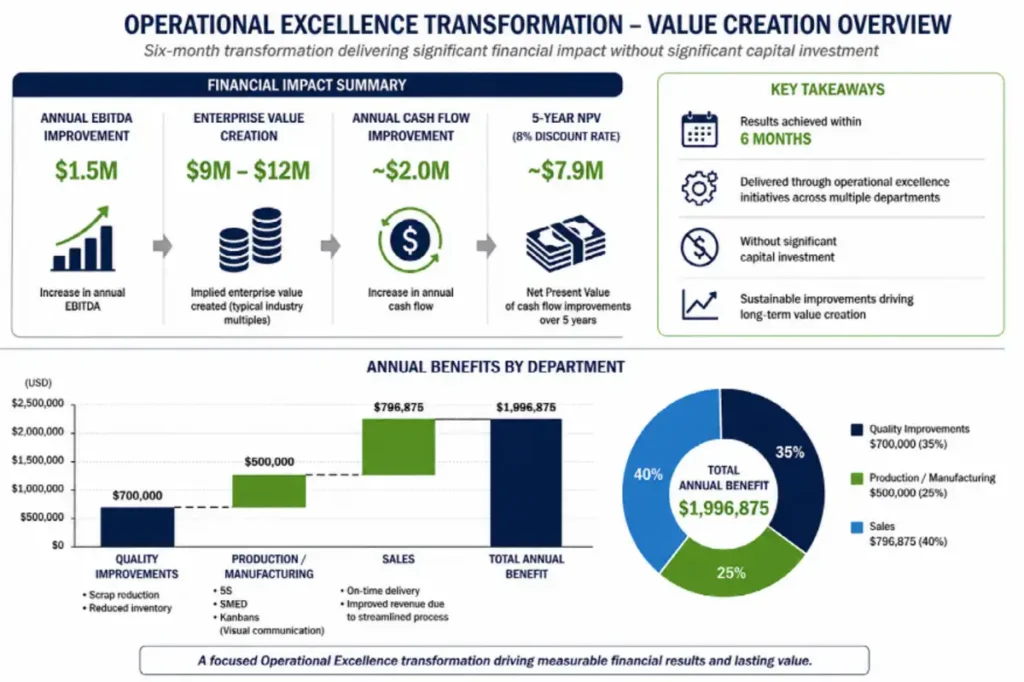
EBITDA increased from approximately $1.76M to $3.26M (~85% increase). Margin improved from 12.4% to 21.7%. Cost savings included ~$500K in labor and ~$700K in materials. Revenue increased by ~$800K due to improved throughput and delivery performance. Working capital improvements further enhanced cash flow.
Value Creation
The transformation generated approximately $1.5M in annual EBITDA improvement, implying $9M–$12M in enterprise value creation based on typical industry multiples.
In addition, the initiative delivered approximately $2.0M in annual cash flow improvements, resulting in a five-year Net Present Value (NPV) of ~$7.9M, using an 8% discount rate.
These results were achieved within a six-month period and without significant capital investment.
Speed of Execution
Initial improvements were realized within 90 days, with full transformation achieved in six months, without major capital expenditures.
Sustainability & Scalability
Lean leadership training, KPI dashboards, and structured management routines were implemented to sustain gains and enable replication across other operations.
Key Insight
Operational execution, not strategy alone, is often the primary driver of value creation in industrial investments.
Next Steps for Executive Consideration
For executives evaluating how to improve cost structure, operational performance, cash flow, and long-term competitiveness, a structured Operational Excellence strategy can be a powerful value creation lever.
To learn more about AM Saxum’s Operational Excellence, Lean Six Sigma, and Lean Leadership advisory services—or to discuss your organization’s specific priorities—contact AM Saxum at 1-888-772-2809 or reach us through the appropriate contact page:
This case study describes a transformation conducted within a global pipe manufacturing organization. Certain details have been generalized to protect client confidentiality.