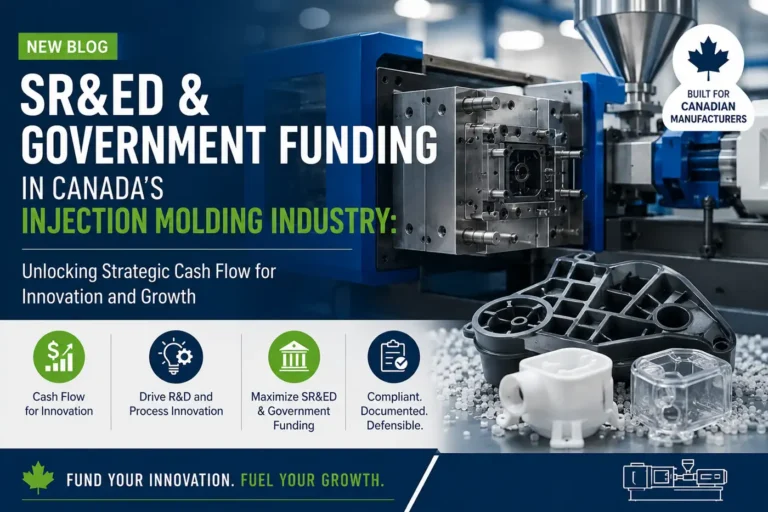
Tax Credits for Canada’s Defense Manufacturing Sector are now a strategic necessity under the 2026 Defence Industrial Strategy. With recent enhancements to the SR&ED program—including an increase in the enhanced refundable expenditure limit from $3 million to $6 million for eligible companies, and the reinstatement of capital expenditure eligibility—contractors can significantly offset the high costs of R&D in areas such as drones and quantum technologies.
Executive Summary: SR&ED for Canada’s Defense Supply Chain

- Strategic Cash Flow: For Tier 2 and Tier 3 suppliers, SR&ED is a critical financial instrument to offset the high cost of meeting the rigorous tolerances and material requirements demanded by prime contractors.
- Uncovering “Hidden” R&D: Technical challenges you face daily—such as custom automation, composite iterations, or scaling prototype designs—often qualify for significant cash recovery, even if they aren’t labeled “R&D.”
- Proven Success: With a 96%+ success rate and over $100M secured, AM Saxum specializes in the complex manufacturing environments unique to the defense industry, ensuring technical robustness and audit readiness.
Canada’s Defense Supply Chain Is Expanding Under Pressure
Across Canada, Tier 2 and Tier 3 defense manufacturers are experiencing a shift in demand patterns driven by global geopolitical instability and increasing requirements from prime contractors. Companies involved in machining, electronics, composites, precision fabrication, and automation are being asked to deliver higher volumes, tighter tolerances, and more advanced capabilities, often within compressed timelines.
These organizations face intense financial and operational pressures. Technical uncertainties, strict compliance, and thin margins from competitive bidding create a highly complex environment.
In this context, innovation is not optional. It is a requirement to remain relevant within defense supply chains. However, innovation comes with financial risk. Canadian government funding programs, particularly SR&ED, play a critical role in mitigating that risk while supporting ongoing technological advancement.
SR&ED as a Strategic Financial Instrument for Defense Manufacturers
The Scientific Research and Experimental Development (SR&ED) program is one of Canada’s most significant government incentives for organizations engaged in technological advancement. While often perceived as a tax credit, SR&ED is more accurately understood as a strategic financial instrument that supports experimentation and innovation.
For Tier 2 and Tier 3 defense manufacturers, SR&ED can apply to a wide range of activities where technical uncertainty exists and systematic experimentation is required to resolve it. This includes not only product development but also process improvements and manufacturing innovation.
Eligible costs include R&D labor, materials, and subcontractors. Whether refundable or non-refundable, these credits provide a direct boost to your cash flow.
When approached strategically, SR&ED becomes a mechanism to reinvest in innovation, reduce the effective cost of development, and improve capital allocation decisions across engineering and operations.

What Defense Manufacturing Activities Qualify for SR&ED?
In the defense sector, technological challenges are often embedded in day-to-day operations. Many organizations are already performing SR&ED-eligible work without formally recognizing it.
Typical examples include:
- Developing new machining strategies to achieve tighter tolerances or improve performance of complex components under challenging material conditions.
- Iterating composite materials or fabrication techniques to meet strength, weight, or durability requirements not achievable with standard processes.
- Designing and testing custom automation systems to improve production consistency while maintaining strict quality standards.
- Resolving integration challenges in electronic systems where performance variability or environmental conditions introduce uncertainty.
- Scaling prototype designs into production environments where performance outcomes are not yet predictable.
These activities share a common characteristic: they involve uncertainty that cannot be resolved through standard practice and require structured experimentation to achieve a technological advancement.
Beyond SR&ED: Complementary Government Funding Programs
In addition to SR&ED, Canadian defense manufacturers may benefit from a broader ecosystem of government funding programs designed to support innovation and growth.
These can include federal and provincial grants that support capital investments, adoption of advanced technologies, workforce development, and collaborative research initiatives. While not all programs apply universally, many organizations in the defense supply chain can access targeted funding aligned with their strategic priorities.
A coordinated approach to government funding allows organizations to leverage multiple programs in parallel, improving financial flexibility while accelerating innovation initiatives.
Maximizing SR&ED Value While Maintaining Technical Rigor
Capturing the full value of SR&ED requires more than identifying eligible projects. It depends on the ability to clearly articulate the technological challenges addressed and the systematic approach taken to resolve them.
Organizations that achieve consistent results typically implement structured documentation practices that align technical activities with financial tracking. This includes capturing experimentation steps, tracking iterations, and linking labour and material costs to specific development efforts.
In many cases, eligible activities are under-claimed because they occur across multiple departments or facilities and are not formally identified as part of an SR&ED strategy. A disciplined approach helps uncover these opportunities while strengthening the overall quality of claims.
Equally important is maintaining technical robustness. Well-prepared claims reduce exposure to review while reinforcing credibility with tax authorities. The objective is not only to maximize the claim value but to ensure that it is fully supportable.
Financial Impact and Strategic Value
For defense manufacturers operating in a capital-intensive and highly competitive environment, SR&ED can have a meaningful financial impact.
By reducing the effective cost of innovation, organizations can improve cash flow and reinvest in further development initiatives. This creates a compounding effect where innovation becomes more sustainable and less dependent on internal funding constraints.
From a financial perspective, SR&ED contributes to improved profitability and can have a direct positive impact on EBITDA by reducing the net cost of innovation and development activities. It also enhances long-term competitiveness by enabling continuous improvement in products and processes.
For CFOs and financial leaders, SR&ED should be viewed as a strategic lever within broader capital planning, not as an isolated tax exercise.
Why AM Saxum
AM Saxum supports organizations in aligning their innovation activities with available government funding programs through a structured and strategic approach.
With over 20 years of experience, AM Saxum has secured more than $100 million in government funding for clients across a wide range of industries, including complex manufacturing environments. The firm maintains a success rate exceeding 96% across SR&ED and grant applications.
AM Saxum’s team combines technical and financial expertise, allowing them to identify eligible activities while minimizing disruption to daily operations. Their client-centric approach ensures that internal teams remain focused on execution while funding strategies are managed effectively.
Rather than operating as a transactional service provider, AM Saxum acts as a strategic advisor, helping organizations strengthen their funding strategy, improve documentation practices, and maximize the value of available programs.
Next Steps for Executive Consideration
For Canadian organizations assessing how to better align innovation activities with available government funding programs, a structured SR&ED strategy can provide meaningful financial support while strengthening long-term competitiveness.
To learn more about AM Saxum’s SR&ED and Government Funding advisory services, or to discuss your organization’s innovation and funding priorities, you may contact AM Saxum at 1-888-772-2809 or reach out through our contact page: