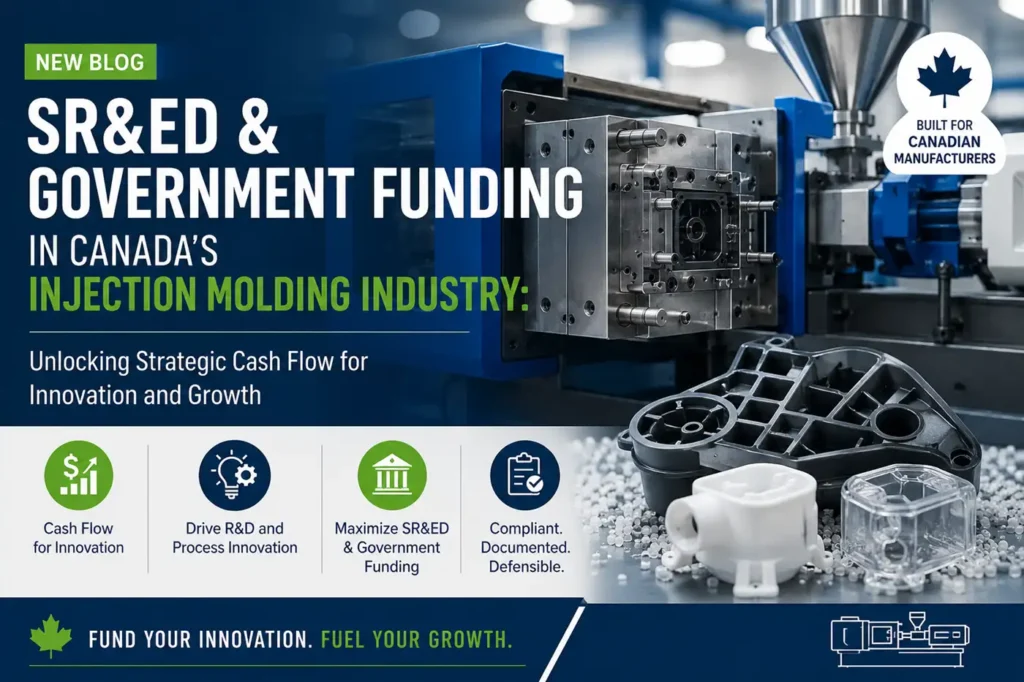
Canada’s injection molding sector operates at the intersection of precision engineering, materials science, and intensifying cost pressure. Manufacturers across the automotive, medical device, and industrial supply chains are required to invest continuously in tooling advancement, process development, and material qualification — often in environments where margins are tight and capital is closely managed. In this context, SR&ED and government funding in the injection molding industry represent a substantive and frequently underutilized source of strategic capital. For executives and financial leaders, understanding how these programs work — and how to leverage them effectively — is a legitimate priority, not an afterthought.
The Innovation Imperative and Financial Reality
The pressures facing Canadian injection molders are structural, not cyclical. Automotive Tier 1 and Tier 2 suppliers are managing the shift to electric vehicle platforms, lightweighting requirements, and increasingly complex part geometries. Medical device manufacturers face biocompatibility standards alongside the operational demands of cleanroom-compatible production. Across sectors, customers are demanding tighter tolerances, shorter cycle times, and sustainable material solutions — simultaneously.
The common thread is that resolving these challenges requires genuine experimentation — and experimentation costs money. The capital required to develop, test, and qualify new tooling designs, material formulations, and process configurations rarely fits within standard operating budgets. Government funding programs exist, in part, to address exactly this gap.
SR&ED as a Strategic Financial Instrument
The Scientific Research and Experimental Development (SR&ED) program is Canada’s largest federal innovation incentive, administered by the Canada Revenue Agency. For Canadian-controlled private corporations, SR&ED can generate refundable investment tax credits of up to 35% on eligible expenditures — including R&D labour, materials consumed in experimentation, and qualifying subcontractor costs. For larger corporations, non-refundable credits at 15% remain available and materially reduce the effective cost of innovation.
The strategic case for SR&ED is not limited to its tax efficiency. It functions as a risk-sharing mechanism — returning capital to organizations that bear the cost and uncertainty of systematic development work. When a process engineer runs iterative trials to resolve a warpage issue under new material conditions, or when a tooling team tests novel cooling configurations to achieve cycle time targets, that work carries genuine technical uncertainty. SR&ED is designed to recognize it. Positioning SR&ED as a financial reinvestment tool — rather than an administrative exercise — is the shift that generates lasting organizational value.
SR&ED-Eligible Activities in the Injection Molding Industry
The scope of eligible activities is broader than most organizations anticipate. The following examples are illustrative — eligibility ultimately rests on the presence of technological uncertainty and a systematic approach to resolving it:
- Advanced material qualification: Evaluating engineered resins or filled compounds to meet performance specifications — elevated-temperature resistance, structural integrity, or biocompatibility — where existing materials or processing knowledge does not reliably predict outcomes.
- Mold and tooling innovation: Developing novel gate designs, cooling channel configurations, or runner geometries to address persistent defects such as sink marks, warpage, or inconsistent fill — when the solution cannot be derived from supplier guidance or standard engineering practice.
- Process parameter development: Systematically investigating the interaction of barrel temperature, injection pressure, and hold conditions for new material or geometry combinations where simulation tools do not provide sufficient predictive accuracy.
- Automation and custom end-of-arm tooling: Engineering part-handling or in-line inspection systems for applications where commercially available hardware cannot meet part-specific requirements, requiring iterative development and testing.
- Sustainable and recycled material integration: Processing post-consumer or post-industrial recycled content in structural applications where material variability introduces processing uncertainty not resolvable through standard qualification methods.
- Multi-component and insert molding advancement: Developing over-molded assemblies involving dissimilar materials where adhesion performance, differential shrinkage, or thermal requirements present unresolved engineering challenges.
Beyond SR&ED: The Broader Government Funding Landscape
SR&ED is the most broadly applicable program for Canadian manufacturers, but rarely the only available lever. The National Research Council’s Industrial Research Assistance Program (IRAP) provides advisory and financial support for technology development among small and medium enterprises. Regional Development Agencies — FedDev Ontario, PrairiesCan, ACOA, and their counterparts — offer capital investment grants, workforce development funding, and sector-specific innovation support. At the provincial level, Ontario, Québec, and Alberta each maintain complementary incentive frameworks that can stack meaningfully with federal credits. For organizations operating across multiple provinces or facilities, a coordinated funding strategy that captures federal and provincial programs simultaneously is both achievable and financially significant.
Maximizing SR&ED Value While Ensuring Technical Robustness
The organizations that realize the most value from SR&ED are those that treat it as an ongoing strategic function rather than an annual event. This means maintaining contemporaneous technical documentation at the project level, building cost-tracking systems capable of isolating R&D labour and materials from production activity, and conducting structured reviews to surface eligible work across departments and facilities that might otherwise go unclaimed.
Multi-site manufacturers in particular frequently leave value on the table. Qualifying activities at a tooling facility or secondary plant carry the same eligibility as work conducted at the primary manufacturing location — but require deliberate identification and documentation. A rigorous approach to claim preparation also reduces audit exposure. Well-constructed technical narratives and clean cost allocations are the most effective means of supporting a claim through CRA review without operational disruption.
Financial Impact: What SR&ED Means for the Balance Sheet
A manufacturer investing $1.5 to $2 million annually in qualifying R&D labour and materials can expect to recover $400,000 to $700,000 in combined federal and provincial credits — refundable in cash for eligible CCPCs. Compounded over several claim years, the cumulative effect on EBITDA, free cash flow, and R&D reinvestment capacity is material. Beyond the direct recovery, SR&ED reduces the net cost of each innovation cycle — enabling organizations to pursue higher-risk process improvements and accelerate development timelines without proportionally increasing financial exposure. For CFOs and Controllers managing constrained capital, this fundamentally changes the economics of R&D investment.
Why AM Saxum
AM Saxum is a Canadian management consulting firm with over 20 years of experience advising organizations across diverse industrial and commercial sectors on SR&ED and government funding strategy. The firm has secured more than $100 million in government funds for clients and maintains a 96%+ approval rate across SR&ED and grant applications.
What distinguishes AM Saxum from a transactional claims preparer is the depth and structure of its advisory approach. The firm has developed a proprietary SR&ED tracking system that enables clients to capture eligible activities in real time — reducing the retrospective documentation burden and improving the technical quality of each submission. The engagement model is designed to minimize disruption to client operations while maximizing the financial and strategic value of each claim. For injection molding organizations across the supply chain — from Tier 1 automotive suppliers to specialty medical manufacturers — AM Saxum brings sector-informed expertise that spans engineering, finance, and government funding program requirements.
Next Steps for Executive Consideration
For Canadian injection molding organizations assessing how to better align their innovation activities with available government funding programs, a structured SR&ED strategy can provide meaningful financial support while strengthening long-term competitiveness.
To learn more about AM Saxum’s SR&ED and Government Funding advisory services, or to discuss your organization’s innovation and funding priorities, you may contact AM Saxum at 1-888-772-2809 or reach out through our