
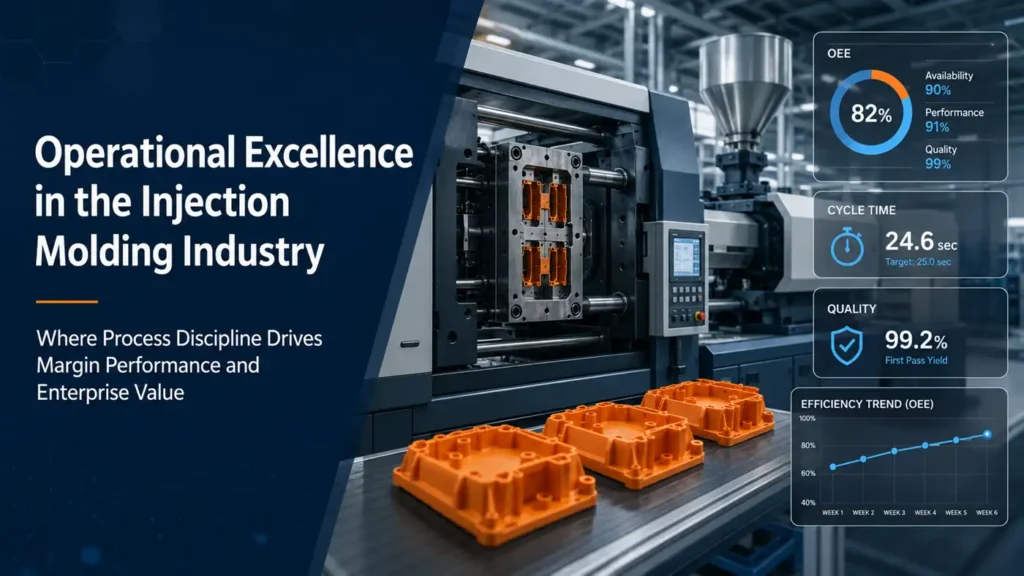
Where Process Discipline Drives Margin Performance and Enterprise Value
When Toyota systematically standardized its injection molding operations in the 1980s, the impact extended well beyond any single production metric. Cycle time variability declined sharply, scrap rates fell, and mold changeover times dropped from hours to minutes. The lesson was clear: operational discipline applied at the molding floor carries the same strategic weight as capital investment. For injection molding manufacturers competing in today’s margin-compressed environment, that principle has never been more relevant.
An Industry Under Structural Pressure
Injection molding manufacturers operate in one of the most financially demanding environments in discrete manufacturing. They serve automotive, medical device, consumer goods, and electronics OEMs — sectors where long-term supply agreements lock in pricing while input costs remain volatile. The ability to pass cost increases downstream is structurally limited, and margin recovery after contract award is rarely an option.
Resin and material costs typically represent 40–60% of total product cost, subject to petrochemical market swings largely beyond the molder’s control. Energy demands driven by the thermal requirements of the molding process add further fixed-cost pressure. Meanwhile, customers increasingly require supplier-managed inventory programs, just-in-time delivery windows, and near-zero defect performance — expectations that demand both operational precision and financial discipline to fulfill profitably.
Capital intensity compounds the challenge. Injection presses represent significant long-cycle investments — from $200,000 to over $2 million per unit — yet press utilization rates across the industry frequently fall below 70%. When capacity is underutilized due to unplanned downtime, extended changeovers, or quality-driven production interruptions, fixed-cost absorption deteriorates and EBITDA erodes with it.
Why Operational Excellence Is a Strategic Imperative in Injection Molding
Operational Excellence in the injection molding industry is not a continuous improvement initiative managed at the shop floor level — it is the operating system through which executives protect margin, sustain competitiveness, and create enterprise value. In an environment where pricing power is constrained and cost structures must absorb market volatility, operational discipline is the most reliable lever available to senior leadership.
Organizations that achieve true Operational Excellence build cost structures that are resilient under pressure. They deliver consistent quality and on-time performance across customer commitments, and they demonstrate the management control systems that retain OEM customers and win new business. These are not operational achievements — they are strategic differentiators that directly influence pricing credibility, customer retention, and enterprise valuation.
The increasing complexity of injection molding applications — multi-material components, precision medical parts, thin-wall structural assemblies — further raises the stakes. Complexity amplifies variability. Variability, left unmanaged, drives scrap, inflates cycle times, and systematically destroys yield and margin.
Lean Six Sigma as the Execution Framework
Lean Six Sigma functions as the structured execution system through which Operational Excellence strategy is translated into measurable, sustainable results. In the injection molding context, it is not a certification program or a toolkit — it is a performance management framework aligned to financial and operational objectives.
Applied with rigor, Lean Six Sigma:
- enables leadership teams to identify the root causes of yield loss and cycle time variability,
- eliminate non-value-added activity embedded in changeover sequences and material handling,
- establish standardized processes that sustain performance across shifts and operators,
- and create management systems that make operational performance visible in real time.
The DMAIC methodology ensures that improvements are evidence-based, financially quantified, and structurally embedded — not temporary fixes that revert when attention moves elsewhere.
The Operational Realities That Limit Performance — and the Levers That Drive It
Injection molding operations are governed by a specific set of production physics and operational constraints that create predictable — and addressable — patterns of waste, variability, and cost. Understanding these realities at the executive level is the foundation of any meaningful improvement strategy.
Cycle Time Stability and Process Conformance
Inconsistencies in melt temperature, injection pressure, hold pressure, and cooling time introduce part-to-part variability that drives scrap, rework, and downstream quality failures. Cycle time conformance is simultaneously a quality, throughput, and cost issue — and one of the highest-leverage targets in any injection molding improvement program.
Mold Changeover Efficiency (SMED)
In high-mix, lower-volume operations, changeover duration is among the most significant capacity constraints on the floor. Extended mold changeovers reduce effective press utilization and inflate fixed-cost absorption rates. Structured changeover reduction initiatives routinely deliver 15–25% effective capacity improvement without capital outlay.
Overall Equipment Effectiveness (OEE)
Press OEE across the injection molding industry frequently ranges from 55–70%. Structured improvement of availability, performance rate, and quality rate to the 80%+ range creates substantial capacity headroom and fundamentally improves the fixed-cost economics of the operation — without the capital commitment of additional press acquisition.
Scrap and Rework Rate Reduction
Material scrap and rework carry compounding costs in injection molding — wasted resin, machine time, energy, labor, and delivery risk. For operations running engineering-grade or specialty resins, the cost per defective part is material. Root-cause elimination through process control delivers direct, measurable EBITDA impact.
Preventive and Predictive Maintenance
Mold wear and press downtime from inadequate maintenance programs represent a significant and frequently underestimated drag on capacity and quality performance. Structured maintenance systems protect asset life cycles, reduce unplanned interruptions, and sustain production reliability at planned utilization rates.
Inventory and Material Flow Management
Resin inventory, WIP accumulation between production stages, and finished goods buffers represent trapped working capital with real carrying costs. Demand-driven flow and pull-based scheduling reduce inventory investment while improving customer responsiveness and delivery performance.
Financial Impact and Enterprise Value Creation
When injection molding operations achieve measurable improvement across these performance levers, the financial impact is both material and compounding. A 5–8 point improvement in OEE across a multi-press facility is equivalent to adding significant press capacity without capital investment. Scrap rate reductions of 1–2 percentage points in resin-intensive operations translate directly into cost savings that flow through to EBITDA. Changeover time reduction frees capacity that supports volume growth without proportional fixed-cost expansion.
For Private Equity-backed injection molding platforms, structured operational improvement generates EBITDA expansion that directly elevates enterprise value at exit multiples. For independent operators, it creates the cost structure resilience needed to compete for and sustain long-term supply agreements on financially viable terms. Working capital efficiency — achieved through resin inventory reduction, lower WIP, and improved on-time delivery — further improves free cash flow generation and strengthens the balance sheet.
Why AM Saxum
AM Saxum brings more than 20 years of hands-on experience in operational transformation across manufacturing-intensive industries, having supported clients in delivering over $500 million in documented cost savings. Our consultants bring deep, industry-specialized expertise — not generalist methodologies applied uniformly — and work embedded within client operations to accelerate performance and build durable internal capability.
With local presence in key markets, AM Saxum minimizes the cost and operational disruption associated with traditional consulting engagements while maximizing execution pace. Our mandate is sustained, measurable performance improvement — delivered through a collaborative model that transfers ownership to the client organization.
Next Steps for Executive Consideration
For executives evaluating how to improve cost structure, operational performance, and long-term competitiveness, a structured Operational Excellence strategy can be a powerful lever.
To learn more about AM Saxum’s Operational Excellence, Lean Six Sigma, and Lean Leadership advisory services, or to discuss your organization’s specific priorities, you may contact AM Saxum at 1-888-772-2809 or reach out through our Contact page