Executive Summary: Powering Automation Through Strategic Funding
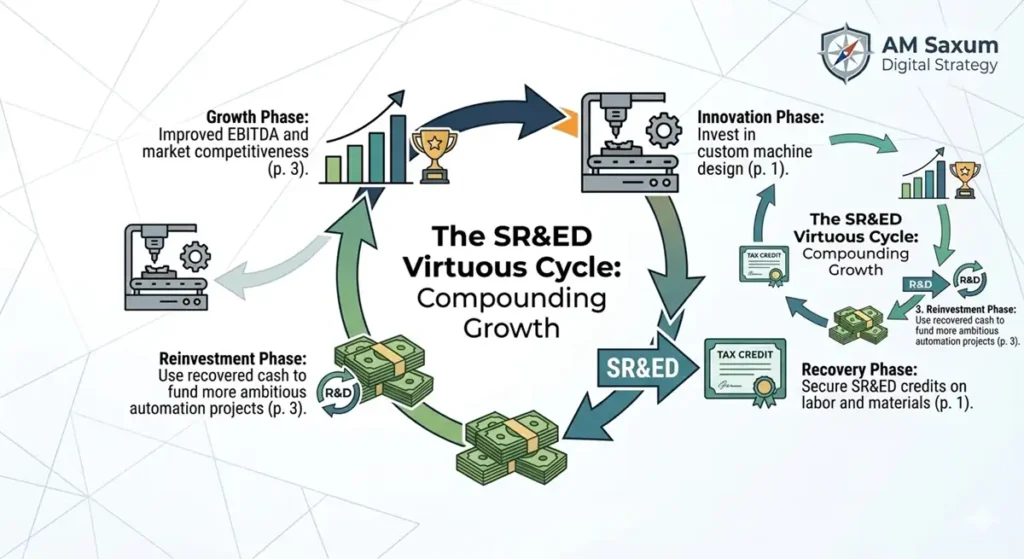
- Cash Flow Catalyst: SR&ED is not just a tax credit; it’s a reinvestment mechanism that lowers the net cost of engineering and development.
- Identifying “Hidden” R&D: Daily engineering hurdles—like resolving throughput variability or system integration challenges—are often prime candidates for significant cash recovery.
- Strategic Advantage: AM Saxum has secured $100M+ for Canadian firms, maintaining a 96%+ success rate to ensure your innovation remains a competitive asset, not a financial burden.
Innovation Pressure in Custom Machinery & Automation
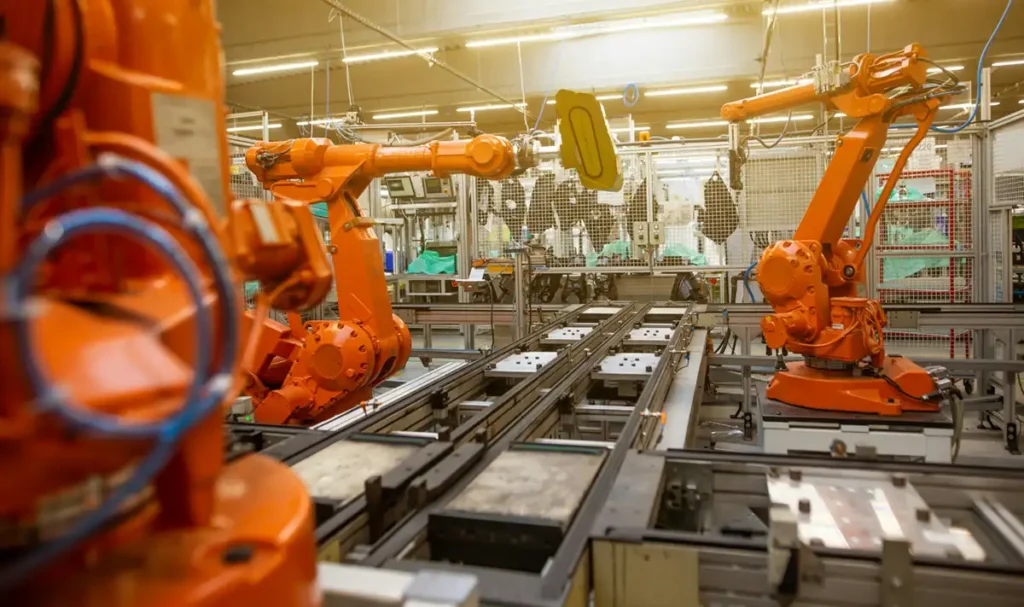
Canadian companies operating in the custom machinery and automation sector are at the forefront of industrial innovation. These organizations design and build highly specialized equipment tailored to unique production requirements across manufacturing, food processing, packaging, and other sectors.
By nature, this work involves a high degree of technical uncertainty. Each project often requires new configurations, integration of multiple systems, and iterative testing to achieve performance targets. At the same time, companies face increasing pressure to deliver faster, meet tighter specifications, and remain cost-competitive in a global market.
The capital intensity of engineering, prototyping, and testing further compounds this challenge. Investments in design, materials, and skilled labour are required well before project outcomes are fully predictable. In this environment, government funding programs such as SR&ED can play a critical role in supporting innovation while protecting cash flow and reducing financial exposure.
SR&ED as a Strategic Financial Instrument
The Scientific Research and Experimental Development (SR&ED) program is one of Canada’s most important incentives for organizations engaged in technological advancement. While often perceived as a tax credit, SR&ED functions as a strategic financial instrument that supports experimentation and innovation.
In the custom machinery and automation sector, SR&ED applies to activities where technical uncertainty exists and cannot be resolved using standard engineering practices. This includes the development of new machine designs, integration of complex systems, and efforts to achieve performance outcomes that require iterative testing and refinement.
Eligible expenditures typically include engineering labour, materials used in prototyping and testing, and subcontractor costs associated with development activities. Depending on the company’s structure, a portion of these expenditures may be recovered through refundable or non-refundable tax credits, directly improving cash flow.
When approached strategically, SR&ED enables organizations to reinvest in innovation, reduce the effective cost of development, and strengthen their overall capital allocation strategy.
What Custom Machinery Projects Qualify for SR&ED in Canada?
Many companies in this sector are already performing SR&ED-eligible work as part of their normal operations. Common examples include:
- Developing custom automation systems where integration challenges require iterative testing to achieve desired throughput or reliability.
- Designing new machinery configurations to meet unique client specifications where standard solutions are not sufficient.
- Resolving performance variability in systems involving robotics, motion control, or sensor integration under real operating conditions.
- Prototyping and testing new equipment to validate functionality, durability, or precision requirements.
- Improving existing machine designs to address limitations in speed, accuracy, or consistency that cannot be resolved through conventional adjustments.
These activities are characterized by technological uncertainty and a systematic approach to experimentation, which are key considerations for SR&ED eligibility.
Beyond SR&ED: The Broader Government Funding Landscape
In addition to SR&ED, Canadian companies in the custom machinery and automation sector may benefit from a range of complementary government funding programs.
These programs can support capital investments in new equipment, adoption of advanced technologies, workforce training, and expansion initiatives. While eligibility varies by program and region, a coordinated funding strategy can allow organizations to leverage multiple sources of support simultaneously.
By aligning funding opportunities with business objectives, companies can enhance financial flexibility and accelerate innovation without placing additional strain on internal resources.
Maximizing SR&ED Value While Maintaining Technical Rigor
Capturing the full value of SR&ED requires a disciplined approach that integrates technical and financial perspectives.
Organizations that maximize their claims typically establish clear documentation practices that link engineering activities to specific technological challenges and experimentation efforts. This includes recording iterations, test results, and decision-making processes throughout the development lifecycle.
It is also important to ensure that all eligible costs are identified and captured accurately. In many cases, companies under-claim because eligible activities are distributed across multiple projects or departments and are not formally tracked.
Maintaining technical robustness is equally critical. Well-supported claims reduce the likelihood of review and strengthen credibility with tax authorities. A structured approach ensures that claims are both optimized and defensible.
Financial Impact and Strategic Value
For companies in the custom machinery and automation sector, SR&ED can have a meaningful impact on financial performance.
By reducing the effective cost of engineering and development activities, SR&ED improves cash flow and enables organizations to reinvest in future projects. It can also have a direct positive impact on EBITDA by lowering net development costs while maintaining revenue levels.
From a strategic perspective, this enhances competitiveness by allowing companies to pursue more ambitious projects, respond to client demands more effectively, and sustain innovation over time. For financial leaders, SR&ED should be viewed as a key component of broader capital planning and growth strategy.
Why AM Saxum
AM Saxum supports Canadian organizations in aligning their innovation activities with available government funding programs through a structured and strategic approach.
With over 20 years of experience, AM Saxum has secured more than $100 million in government funding for clients across a wide range of industries, including complex manufacturing environments. The firm maintains a success rate exceeding 96% across SR&ED and grant applications.
AM Saxum’s consultants combine technical understanding with financial expertise, enabling them to identify eligible activities while minimizing disruption to daily operations. Their client-centric approach ensures that internal teams remain focused on execution while funding strategies are managed efficiently.
Rather than operating as a transactional service provider, AM Saxum acts as a strategic advisor, helping organizations strengthen their funding approach, improve documentation practices, and maximize the value of available programs.
Next Steps for Executive Consideration
For Canadian organizations assessing how to better align innovation activities with available government funding programs, a structured SR&ED strategy can provide meaningful financial support while strengthening long-term competitiveness.
To learn more about AM Saxum’s SR&ED and Government Funding advisory services, or to discuss your organization’s innovation and funding priorities, you may contact AM Saxum at 1-888-772-2809 or reach out through our contact page: https://www.amsaxum.com/ca/contact-us/