Strengthening Operational Discipline to Protect EBITDA in Volatile Energy Markets
Opening Industry Insight
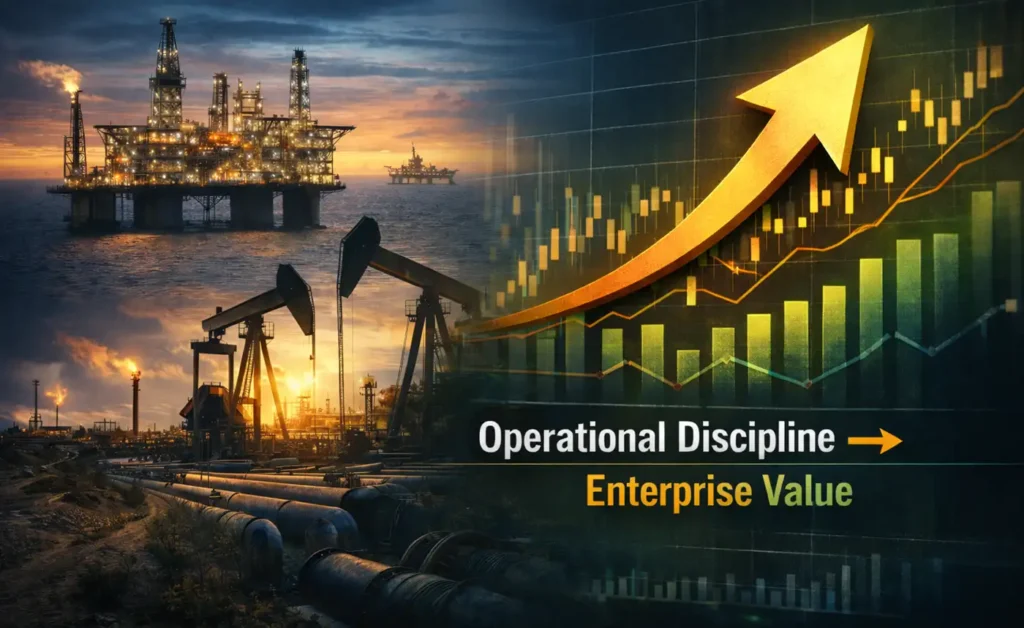
Throughout the history of the oil and gas industry, operational discipline has often determined which companies remain profitable during commodity downturns. During the oil price collapse of 2014–2016, many producers discovered that the difference between resilience and financial distress was not simply the price of crude—it was the efficiency and reliability of their operations. Today, operational performance remains one of the most powerful drivers of financial stability in energy markets.
The Oil & Gas Industry: Operational Pressure and Financial Reality
The oil and gas sector operates within one of the most volatile economic environments of any global industry. Commodity price cycles, geopolitical uncertainty, and capital-intensive infrastructure create constant pressure on margins and return on invested capital. Even during favorable price environments, companies must manage complex production systems, strict regulatory requirements, and rising operational costs.
Executives across upstream, midstream, and downstream operations increasingly recognize that financial performance is shaped as much by operational reliability as by market conditions. Production downtime, inefficient asset utilization, and maintenance disruptions can rapidly erode profitability in an industry where margins are highly sensitive to operational performance.
Mega‑projects, large asset bases, and geographically dispersed operations make operational discipline essential. Facilities such as drilling platforms, refineries, LNG terminals, and pipeline networks require precise coordination and reliability to maintain stable throughput and cost control.
Why Operational Excellence Is a Strategic Imperative in Energy Operations
In this context, Operational Excellence has become a strategic necessity rather than a discretionary improvement initiative.
For oil and gas organizations, disciplined operational management directly affects several performance dimensions critical to long‑term competitiveness:
• Cost structure resilience during commodity price volatility
• Reliable production throughput and facility uptime
• Safe and compliant operations across complex environments
• Reduced operational risk and unplanned shutdowns
• Greater management visibility across distributed assets
When operational systems are inconsistent or poorly integrated, companies often experience hidden performance losses such as production interruptions, inefficient maintenance practices, excess energy consumption, or supply chain inefficiencies. These operational gaps accumulate over time, ultimately reducing EBITDA and weakening financial performance.
A structured Operational Excellence approach enables energy companies to address these challenges systematically while stabilizing production performance and improving operational predictability.
Lean Six Sigma as the Engine of Disciplined Execution
While Operational Excellence defines the strategic objective, Lean Six Sigma provides the structured execution system that translates improvement priorities into measurable results.
In oil and gas environments, Lean Six Sigma functions as a disciplined performance management framework that aligns operational teams with financial objectives. Rather than relying on isolated improvement initiatives, it enables organizations to systematically identify constraints, reduce operational variability, and improve reliability across complex asset networks.
From drilling operations and well production to refining processes and distribution logistics, each stage of the energy value chain contains opportunities to enhance performance when examined through a structured problem‑solving methodology. When leadership teams deploy Lean Six Sigma effectively, operational improvements become measurable, repeatable, and financially meaningful.
Operational Realities that Shape Oil & Gas Performance
The oil and gas industry operates under a unique set of operational realities that significantly influence cost structure and financial outcomes.
Production systems often involve large-scale infrastructure operating in challenging environments—from offshore platforms and remote drilling sites to refineries and pipeline networks spanning thousands of kilometers. These complex systems require high levels of reliability, coordination, and technical discipline.
Variability in reservoir conditions, equipment reliability, and process stability can directly affect production output and operating costs. Even small inefficiencies can translate into significant financial impact due to the scale and capital intensity of energy operations.
Several operational levers consistently influence EBITDA performance across oil and gas operations:
Key Operational Performance Levers
1. Asset Reliability and Equipment Availability
Production facilities, compressors, pumps, and drilling equipment must operate with extremely high reliability. Unplanned shutdowns or equipment failures can interrupt production and generate substantial financial losses.
2. Production Throughput and Facility Utilization
Whether in upstream production or downstream refining, maximizing facility utilization is essential. Bottlenecks or operational instability can reduce throughput and limit revenue generation.
3. Maintenance Strategy and Turnaround Efficiency
Scheduled shutdowns and maintenance turnarounds are critical events in refineries and processing plants. Optimizing maintenance planning and execution significantly affects production continuity and cost performance.
4. Energy Consumption and Process Efficiency
Energy intensity represents a major operating cost across refining and processing operations. Improvements in process efficiency can materially reduce operating expenses.
5. Supply Chain and Logistics Coordination
Oil and gas operations rely on complex logistics networks involving pipelines, storage terminals, shipping, and distribution systems. Inefficiencies in these networks can create costly delays or inventory imbalances.
6. Operational Safety and Compliance Management
Regulatory compliance and operational safety are fundamental requirements in the energy sector. Strong operational discipline reduces the likelihood of safety incidents, environmental risks, and costly operational disruptions.
Energy executives often monitor these drivers through performance indicators such as facility uptime, production efficiency, refinery utilization rates, maintenance backlog levels, and lifting cost per barrel. Operational Excellence initiatives directly influence these metrics and ultimately determine the financial resilience of energy operations.
Financial Impact and Enterprise Value Creation
For energy companies, the financial impact of Operational Excellence initiatives extends far beyond traditional cost reduction.
Improving asset reliability, throughput stability, and process efficiency enables organizations to increase production output without requiring additional capital investment. At the same time, improvements in maintenance planning, energy efficiency, and supply chain coordination strengthen operating margins and cash flow generation.
In a capital‑intensive sector such as oil and gas, even modest operational improvements can produce substantial financial benefits. Higher asset productivity, stronger cost control, and reduced operational variability contribute directly to EBITDA expansion and improved enterprise value.
Operational improvements achieved without major capital expenditures often deliver the highest return on invested capital, particularly during periods of commodity price volatility.
Why AM Saxum
AM Saxum brings more than 20 years of experience helping organizations unlock measurable financial value through Operational Excellence. Across industries, our consultants have helped clients generate over $500 million in cost savings and operational improvements.
Our approach combines disciplined Lean Six Sigma execution with deep operational and leadership expertise. Rather than focusing on isolated improvement projects, we work alongside executive teams to align operational transformation with strategic financial objectives.
AM Saxum’s consultants bring hands‑on industry experience and are located across key cities, allowing us to support client organizations directly at their facilities while minimizing travel costs and operational disruption. Our focus remains consistent: delivering sustainable improvements in operational performance that translate directly into measurable financial results.
Next Steps for Executive Consideration
For executives evaluating how to improve cost structure, operational performance, and long‑term competitiveness, a structured Operational Excellence strategy can be a powerful lever.
To learn more about AM Saxum’s Operational Excellence, Lean Six Sigma, and Lean Leadership advisory services, or to discuss your organization’s specific priorities, you may contact AM Saxum at 1‑888‑772‑2809 or reach out through our contact page.