Industry Innovation Context & Financial Pressure

The Plastics and Moldmaking industry operates at the intersection of engineering precision, capital intensity, and constant competitive pressure. Companies must deliver increasingly complex parts, tighter tolerances, and faster lead times while managing volatile input costs, evolving material requirements, and sustained margin pressure. See our Government Funding Services.
Innovation in this sector is rarely optional. Tooling design, mold performance, material behaviour, and process capability must continuously evolve to meet customer demands and remain competitive. At the same time, these innovation efforts involve significant technical uncertainty. Engineering teams often develop new approaches without clear precedent, while financial leaders must fund experimentation with no guarantee of success.
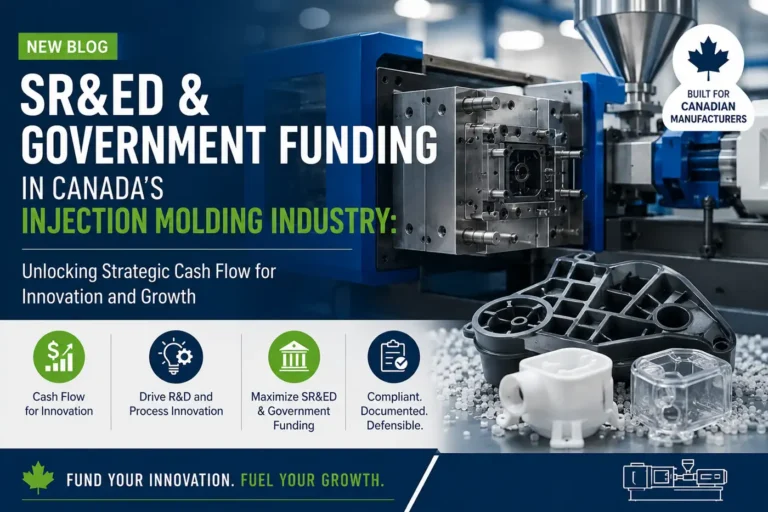
In this context, Canadian government funding programs—particularly the Scientific Research and Experimental Development (SR&ED) program—play a critical strategic role. When approached correctly, they provide a mechanism to support innovation investment while protecting cash flow and reducing financial risk.
Understanding SR&ED as a Strategic Financial Instrument
Many companies misunderstand SR&ED as a tax filing exercise. In reality, it is a strategic financial instrument designed to encourage Canadian companies to undertake experimental development and technological advancement despite uncertainty.
At a high level, SR&ED supports companies that perform work to overcome scientific or technological challenges when solutions are not readily available and must be developed through systematic experimentation. In the Plastics and Moldmaking industry, this frequently includes engineering-driven development rather than laboratory research.
Eligible expenditures typically include labour directly involved in experimental activities, materials consumed during development, and certain subcontracted technical work. Depending on a company’s structure and profitability, SR&ED credits may be refundable or non-refundable, providing either direct cash recovery or a reduction in tax payable.
Positioned strategically, SR&ED functions as a reinvestment mechanism that lowers the effective cost of innovation, mitigates technical risk, and improves capital allocation decisions.
Examples of SR&ED-Eligible Projects in the Plastics and Moldmaking Industry
Technological uncertainty and a structured experimentation process determine SR&ED eligibility—not industry labels or product categories. In the Plastics and Moldmaking industry, eligible activities often arise from day-to-day engineering challenges.
Examples may include:
- Developing new tooling or mold designs to address persistent dimensional instability where existing design rules are insufficient.
- Experimenting with process parameters and cooling strategies to reduce shrinkage variability across different resin families or part geometries.
- Advancing material formulations or processing approaches to successfully incorporate recycled or alternative materials without compromising performance.
- Resolving unexplained surface defects, warpage, or premature tool wear through iterative testing and analysis.
- Designing and validating new manufacturing approaches to achieve tighter tolerances or improved cycle performance under constrained conditions.
These examples are illustrative rather than exhaustive. Companies establish eligibility by demonstrating that technical challenges could not be resolved through standard practice and required systematic investigation.
Beyond SR&ED: Broader Government Funding Landscape
While SR&ED is the cornerstone of innovation funding in Canada, it is not the only program relevant to Plastics and Moldmaking companies. Complementary federal and provincial programs may support capital investment, advanced manufacturing technologies, workforce development, or sector-specific innovation initiatives.
When companies align these programs strategically, they can layer them with SR&ED to support both development and implementation phases of innovation, improving project economics and accelerating return on investment.
Maximizing SR&ED Value While Ensuring Technical Robustness
Maximizing SR&ED value requires more than identifying eligible work after the fact. Successful claims are built on clear technical narratives that articulate the uncertainty faced, the hypotheses tested, and the advancement achieved.
Best practices include implementing structured documentation processes that capture experimentation as it occurs, strengthening cost identification systems to ensure all eligible expenditures are recorded, and periodically reviewing operations to identify under-claimed activities across departments or facilities.
A disciplined approach to claim preparation also reduces avoidable audit exposure. Clear alignment between technical work, financial data, and project narratives demonstrates credibility and supports smoother interactions with tax authorities.
Financial Impact & Strategic Value
When integrated into broader financial planning, SR&ED can have a meaningful impact on organizational performance. Recoveries improve cash flow, enabling companies to reinvest more aggressively in engineering and innovation initiatives.
By reducing the effective cost of experimentation, SR&ED supports stronger R&D reinvestment, improves innovation ROI, and enhances EBITDA performance over time. For organizations operating in competitive, capital-intensive environments, this financial support can provide a decisive advantage.
Why AM Saxum
AM Saxum supports Plastics and Moldmaking organizations as a strategic government funding advisory partner. Our team brings hands-on industry experience and a deep understanding of how engineering-driven innovation unfolds in real manufacturing environments.
With a success rate exceeding 96% across SR&ED and other government funding programs, AM Saxum has helped clients secure over $100 million in government funds. Our client-centric approach minimizes disruption to daily operations while ensuring technical robustness and financial accuracy.
We are not a volume-based claim shop or a tax preparer. We partner with leadership teams to design sustainable SR&ED strategies aligned with long-term innovation and business objectives.
Next Steps for Executive Consideration
For Canadian organizations assessing how to better align innovation activities with available government funding programs, a structured SR&ED strategy can provide meaningful financial support while strengthening long-term competitiveness.
To learn more about AM Saxum’s SR&ED and Government Funding advisory services, or to discuss your organization’s innovation and funding priorities, you may contact AM Saxum at 1-888-772-2809 or reach out through our contact page: