Executive Summary
A joint venture developing a heavy oil asset faced a complete operational breakdown, with zero production, inadequate equipment, no structured operating model, and limited internal expertise. What initially appeared to be a technical challenge was, in reality, a combination of operational, leadership, and execution challenges.
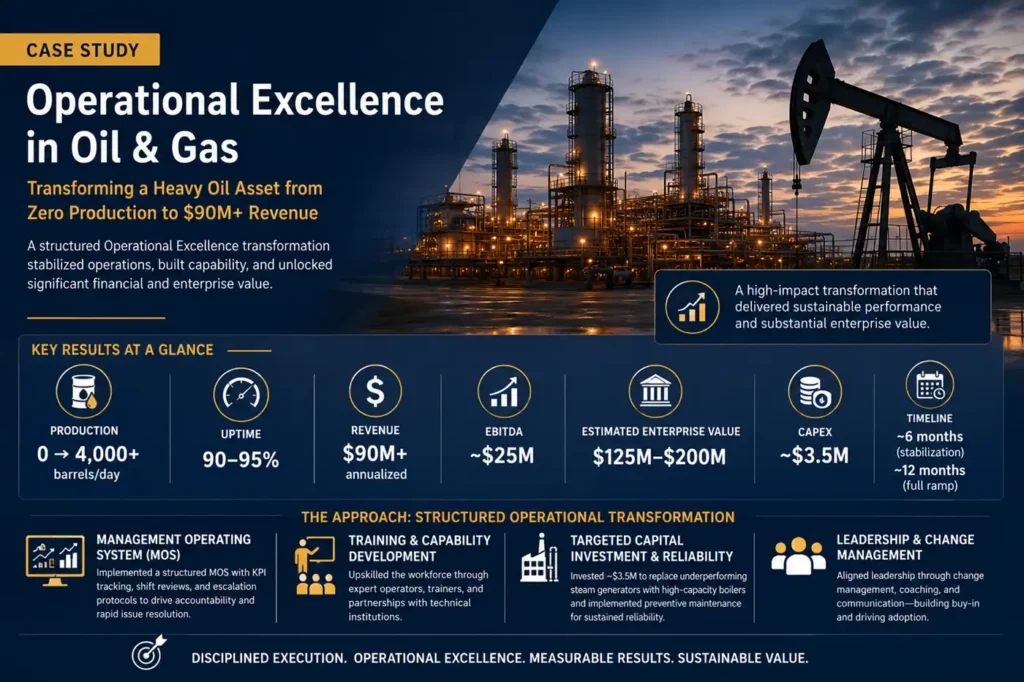
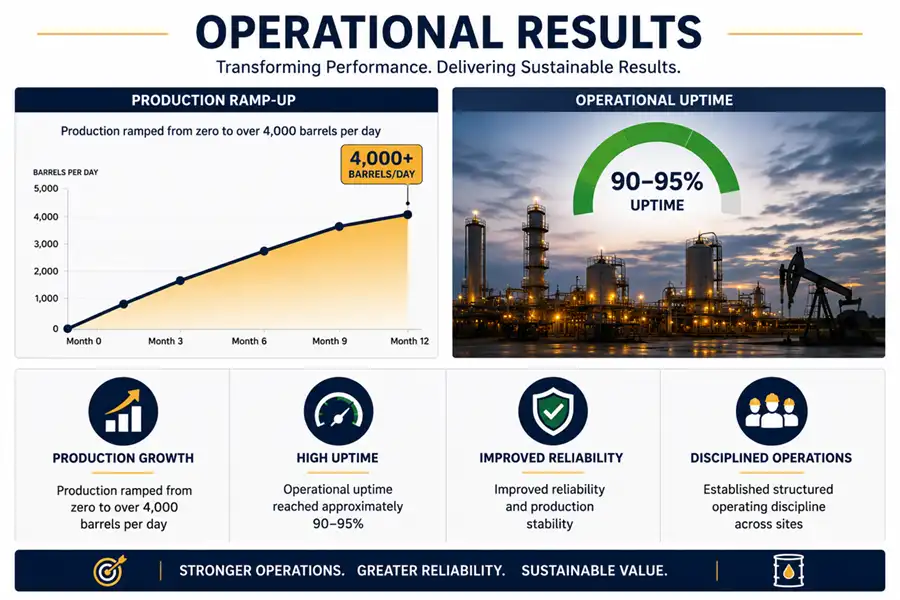
Through a structured Operational Excellence transformation—combining targeted capital investment, leadership alignment, and the implementation of a Management Operating System (MOS)—the operation was stabilized and rapidly scaled. Production ramped from zero to over 4,000 barrels per day within approximately one year.
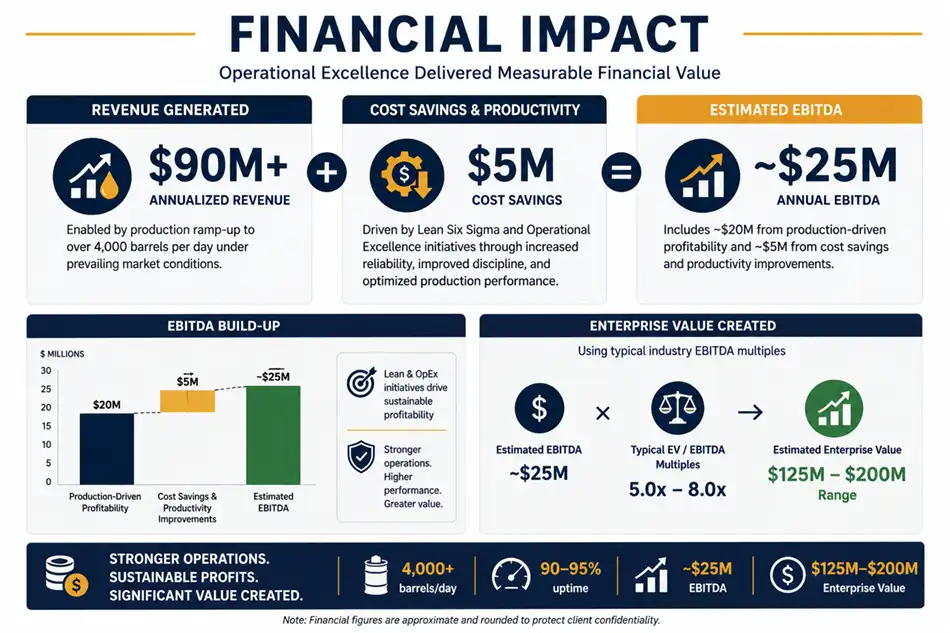
At stabilized production levels, this transformation enabled more than $90M in annualized revenue and approximately $5M in cost savings driven by Lean Six Sigma and Operational Excellence initiatives, contributing to an estimated ~$25M in annual EBITDA at stabilized production levels. Based on typical industry multiples, this corresponds to an estimated enterprise value in the range of approximately $125M–$200M.
Key Results at a Glance
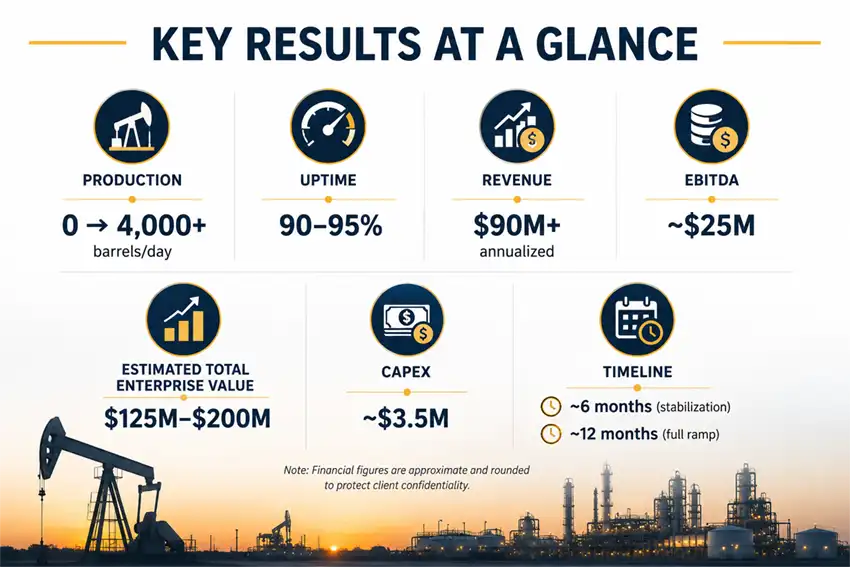
- Production: 0 → 4,000+ barrels/day
- Uptime: 90–95%
- Revenue: $90M+ annualized
- EBITDA: ~$25M
- Estimated Total Enterprise Value: $125M–$200M
- CAPEX: ~$3.5M
- Timeline: ~6 months (stabilization), ~12 months (full ramp)
Client Context & Challenge
The project involved a joint venture developing a heavy oil asset in a region with limited prior experience in this type of operation. While the organization had a strong background in conventional oil production, it lacked the specialized expertise required for heavy oil extraction, which relies on fundamentally different processes such as steam injection.
The operation faced multiple challenges simultaneously: inadequate steam generation equipment, absence of structured training systems, no formal Management Operating System (MOS), and a workforce with limited experience in oilfield operations. As a result, the asset was unable to produce, remaining at zero output despite significant resource potential.
Why This Was Difficult
Heavy oil operations require a significantly more complex and disciplined operating model than conventional oil production. Steam injection processes demand precise control, reliable equipment, and consistent execution. Without these elements, production cannot be sustained.
Additionally, the workforce had limited prior exposure to oilfield operations, requiring rapid capability development. Initial resistance to adopting a new operating model further compounded the challenge, as the transition required a fundamental shift in mindset and execution discipline.
The combination of technical complexity, organizational resistance, and lack of experience created a high-risk environment where failure was a realistic outcome.
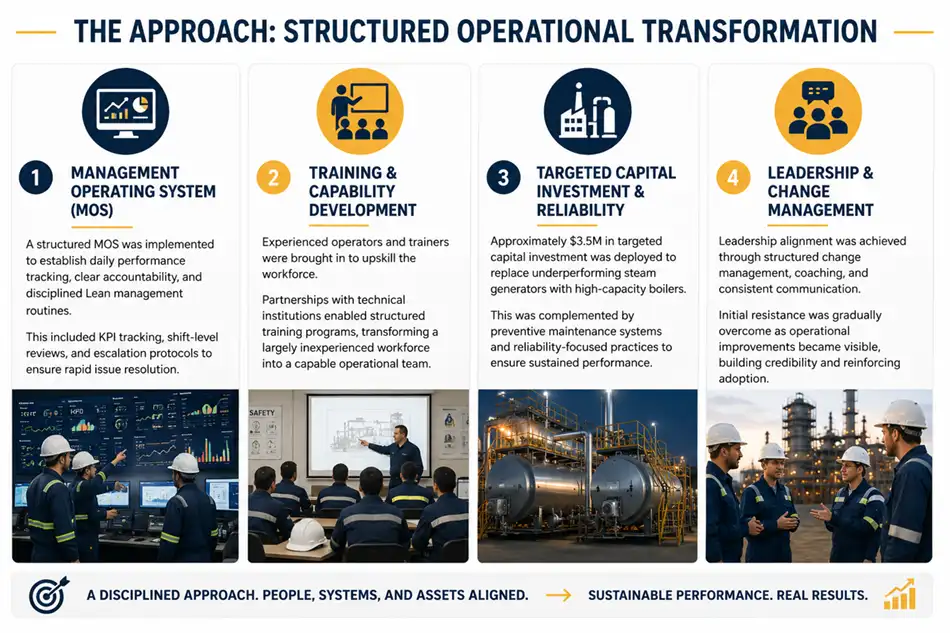
The Approach: Structured Operational Transformation
Management Operating System (MOS)
A structured MOS was implemented to establish daily performance tracking, clear accountability, and disciplined Lean management routines. This included KPI tracking, shift-level reviews, and escalation protocols to ensure rapid issue resolution.
Training & Capability Development
Experienced operators and trainers were brought in to upskill the workforce. Partnerships with technical institutions enabled structured training programs, transforming a largely inexperienced workforce into a capable operational team.
Targeted Capital Investment & Reliability
Approximately $3.5M in targeted capital investment was deployed to replace underperforming steam generators with high-capacity boilers. This was complemented by preventive maintenance systems and reliability-focused practices to ensure sustained performance.
Leadership & Change Management
Leadership alignment was achieved through structured change management, coaching, and consistent communication. Initial resistance was gradually overcome as operational improvements became visible, building credibility and reinforcing adoption.
Breakthrough Insight
A key realization was that the operation’s primary constraint was not the quality of the asset itself, but the absence of a structured operating model capable of supporting heavy oil production.
Once disciplined management systems, workforce capability, and reliability-focused practices were aligned, the operation was able to rapidly stabilize and scale production.
Execution Timeline
Within approximately six months, targeted mechanical upgrades enabled full steam injection, establishing the foundation for stable operations. Over the following months, production ramped steadily, ultimately exceeding 4,000 barrels per day within approximately one year.
Transformation Example: Steam Generation Upgrade
A critical bottleneck was identified in the original steam generation system, which was underpowered for heavy oil extraction. The decision to replace the equipment with higher-capacity boilers enabled full steam injection, dramatically improving reliability and production capability.
This initiative became a critical enabler of stable steam injection, sustained production reliability, and the rapid production ramp-up achieved during the transformation.
Operational Results
- Production ramped from zero to over 4,000 barrels per day
- Operational uptime reached approximately 90–95%
- Improved reliability and production stability
- Established structured operating discipline across sites
Financial Impact
The production ramp-up enabled more than $90M in annualized revenue under prevailing market conditions. In addition, Lean Six Sigma and Operational Excellence initiatives generated approximately $5M in cost savings and productivity improvements through increased reliability, improved operating discipline, and optimized production performance.
At stabilized production levels, the operation generated an estimated ~$25M in annual EBITDA, including both production-driven profitability and operational improvements. Based on typical industry multiples, this corresponds to an estimated enterprise value range of approximately $125M–$200M.
Strategic Impact
The transformation enabled the organization to develop a new operational capability in heavy oil production, positioning the joint venture for future growth and scalability. It demonstrated that disciplined execution, leadership alignment, and structured systems are critical to unlocking value in complex environments.
The project also demonstrated the importance of operational and leadership adaptability when deploying unfamiliar production technologies and operating models.
Leadership Insight
This case highlights that the primary barrier to performance is often not the asset itself, but the ability to execute effectively in unfamiliar environments. Leadership alignment, structured management systems, and capability development are essential to achieving sustainable results.
Conclusion
This transformation demonstrates how Operational Excellence and leadership can unlock significant value, even in technically complex and high-risk environments. The ability to combine targeted investment with disciplined execution is a powerful lever for operational and enterprise value creation.
Next Steps for Executive Consideration
For executives evaluating how to improve cost structure, operational performance, cash flow, and long-term competitiveness, a structured Operational Excellence strategy can be a powerful value creation lever.
To learn more about AM Saxum’s Operational Excellence, Lean Six Sigma, and Lean Leadership advisory services—or to discuss your organization’s specific priorities—contact AM Saxum at 1-888-772-2809 or visit:
This case study describes a transformation conducted within an oil & gas operation. Certain operational and financial details have been generalized or approximated to protect client confidentiality.