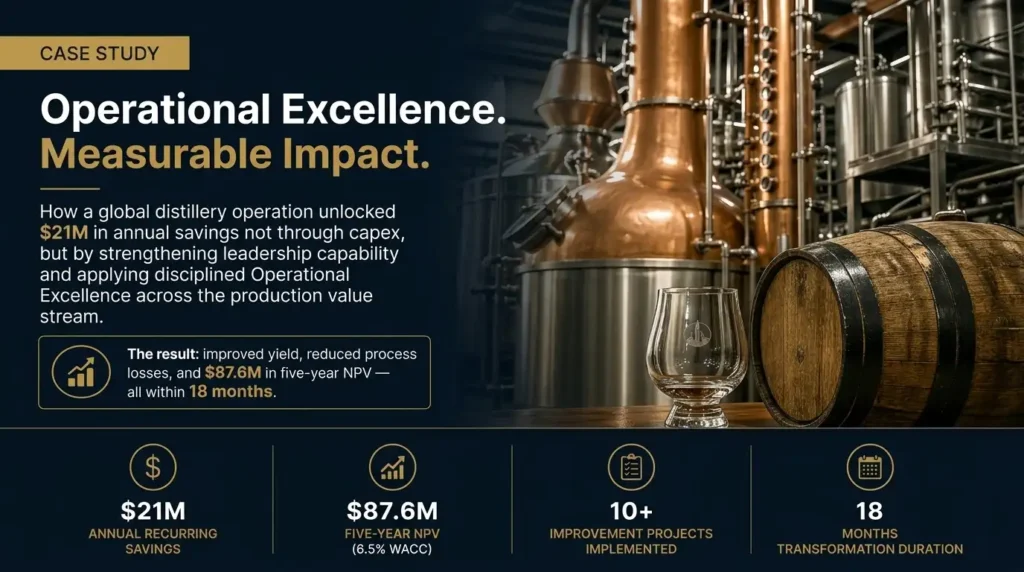
A Lean Six Sigma Transformation Across the Production Value Stream
Executive Summary
Client: Global spirits producer (tequila operations)
Industry: Beverage manufacturing
Transformation duration: 18 months
Facing rapid demand growth and rising operational complexity, a global tequila producer launched an Operational Excellence transformation to increase production capacity, reduce process losses, and strengthen leadership capabilities across the production organization.
The transformation was led by Henry Foppoli, Managing Partner of AM Saxum, focusing on developing internal leadership capability and executing high-impact improvement initiatives across the tequila production value stream.
The program combined structured Lean Six Sigma methodology with leadership coaching to enable operational managers to identify and implement measurable improvements across multiple stages of production.
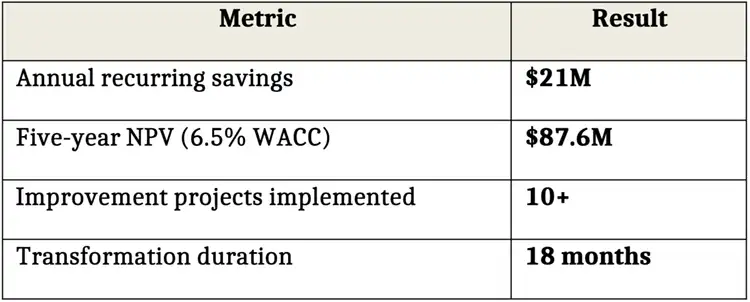
Over an 18‑month transformation, the initiative delivered $21M in recurring annual savings and $87.6M in five‑year Net Present Value (NPV) using a 6.5% WACC, while strengthening the organization’s ability to sustain continuous improvement.
Results
• $21M in recurring annual savings
• $87.6M five‑year Net Present Value (NPV) using a 6.5% WACC
• 10+ operational improvement projects implemented
• Improvements delivered across the full tequila production value chain
Industry & Operational Context
Tequila production is a complex process that combines agricultural variability with highly regulated manufacturing operations. From agave cultivation through fermentation, distillation, and bottling, the production chain involves multiple stages where small variations in process performance can significantly affect yield, throughput, and product quality.
The production facility processes large volumes of agave annually and supports the global distribution of premium tequila products. Maintaining consistent quality while scaling production requires strong operational discipline across multiple interconnected processes.
Demand growth for premium tequila products has increased pressure on producers to expand capacity while maintaining strict quality standards. At the same time, production operations must manage variability in agave sugar content, fermentation efficiency, and distillation performance.
Transformation Challenge
The tequila production operation was facing several challenges that constrained performance across the production chain.
Variability in upstream processes created inefficiencies in downstream operations. Differences in agave quality and processing conditions affected fermentation performance and distillation yields.
Certain production stages had become throughput bottlenecks, limiting the ability of the operation to meet increasing demand. Capacity constraints in cooking, extraction, and aging operations reduced the plant’s ability to fully utilize installed production assets.
In addition, several process losses had accumulated across the manufacturing chain, including yield losses, reprocessing requirements, and inefficient production practices. Collectively, these issues represented a significant financial opportunity if addressed through a structured improvement program.
Transformation Approach
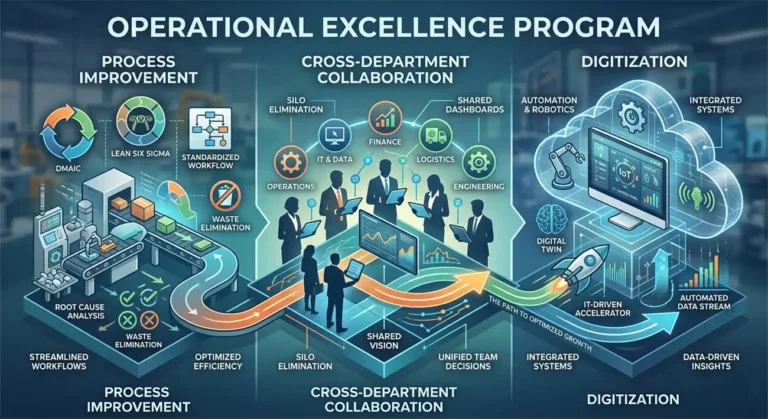
The transformation focused on developing internal leaders capable of identifying and executing high-impact operational improvement initiatives.
The initiative was structured around Lean Six Sigma DMAIC methodology, ensuring that each project followed a disciplined problem‑solving process grounded in operational data and financial validation.
Operational managers were trained to apply Lean Six Sigma tools while strengthening leadership capabilities such as cross-functional collaboration, structured problem-solving, and data-driven decision making.
Operational Excellence Implementation
Over the course of the 18‑month program, operational managers implemented a portfolio of improvement initiatives across the tequila production value stream.
In total, more than ten improvement projects were implemented across the value stream, addressing yield losses, process variability, capacity constraints, and production inefficiencies.
Each initiative followed a structured process including problem definition, data analysis, solution development, and controlled implementation of improvements.
Key Operational Improvements
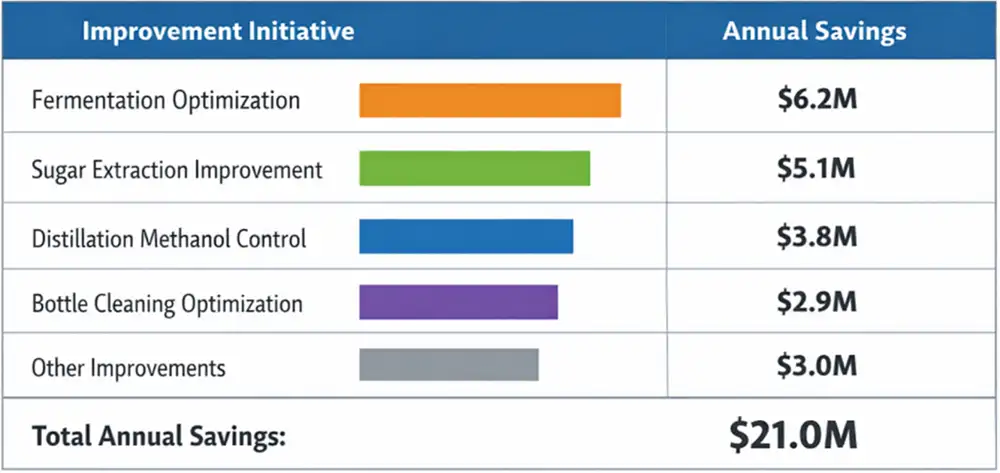
Fermentation Efficiency Optimization
Through structured experimentation and statistical analysis, the operations team optimized fermentation conditions, improving conversion efficiency and stabilizing fermentation cycle times.
Sugar Extraction Improvement
Operational improvements focused on optimizing milling parameters and extraction conditions to reduce sugar losses trapped in the bagasse by‑product, increasing overall tequila yield.
Methanol Control in Distillation
Improved measurement and process control mechanisms reduced reprocessing requirements and increased distillation efficiency.
Bottle Cleaning Process Optimization
The bottling process was redesigned to eliminate the use of product liquid during bottle cleaning, significantly reducing product losses.
Financial Impact
Operational Value Stream Transformation
Improvement initiatives were implemented across the entire tequila production value stream:
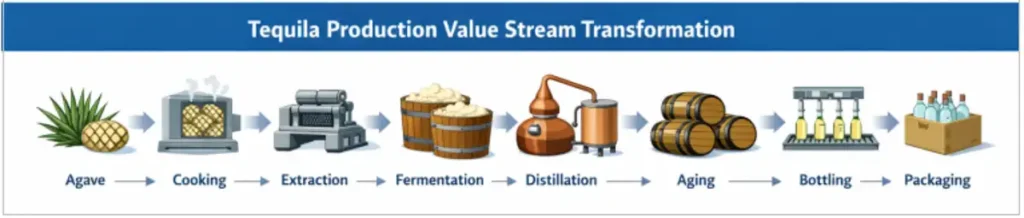
This systemic approach ensured that improvements in one stage of production were aligned with downstream processes, preventing the creation of new bottlenecks elsewhere in the value stream.
Organizational Impact
Beyond financial results, the transformation strengthened leadership capability within the organization. Managers developed stronger problem‑solving skills and gained experience leading cross‑functional improvement initiatives.
The program also reinforced a culture of continuous improvement. Teams became more proactive in identifying performance gaps and implementing operational solutions.
Why This Case Study Matters
This transformation illustrates how a structured Operational Excellence transformation can unlock significant financial value in complex manufacturing environments.
By focusing on leadership capability development and disciplined problem solving, organizations can achieve measurable operational improvements while building sustainable internal expertise.
Why AM Saxum
AM Saxum specializes in leadership-driven Operational Excellence transformations that deliver measurable financial results.
Across industries, AM Saxum consultants have helped organizations generate more than $500 million in operational savings through structured improvement initiatives. With over 20 years of experience in business transformation, the firm combines deep operational expertise with disciplined Lean Six Sigma execution.
AM Saxum’s approach focuses on developing internal leadership capability while delivering sustainable operational improvements.
Next Steps for Executive Consideration
For executives evaluating how to improve cost structure, operational performance, and long-term competitiveness, a structured Operational Excellence strategy can be a powerful lever.
To learn more about AM Saxum’s Operational Excellence, Lean Six Sigma, and Lean Leadership advisory services, or to discuss your organization’s specific priorities, you may contact AM Saxum at 1-888-772-2809 or reach out through our contact page.
This case study describes a transformation conducted within a global beverage manufacturing organization. Certain details have been generalized to protect client confidentiality.