How a structured Operational Excellence program generated financial impact equivalent to 27% of payroll in a mid-size manufacturing company.
Executive Summary
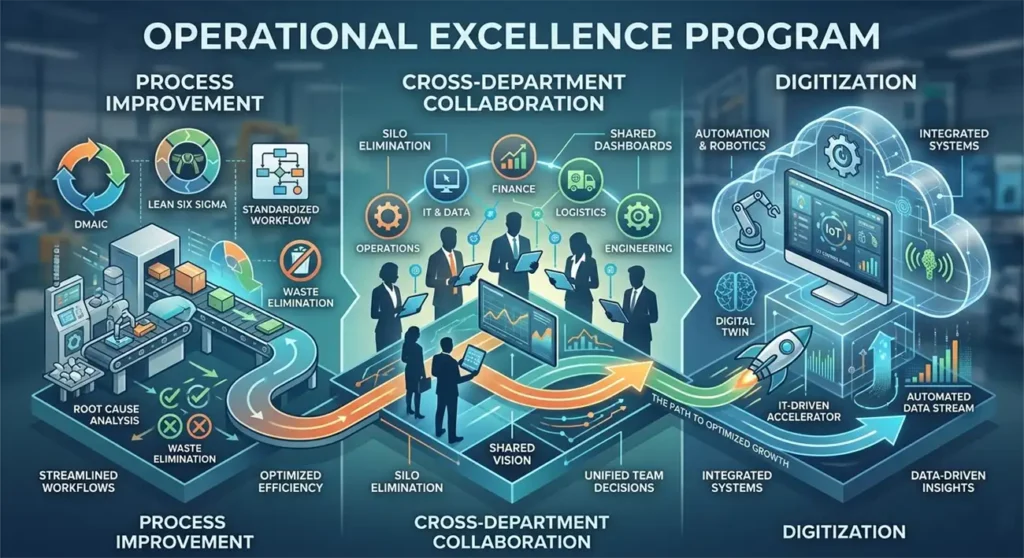
AM Saxum partnered with a specialized mid-size manufacturing company employing approximately 100 people to deploy a structured Operational Excellence program focused on process improvement, digitization, and cross-department collaboration.
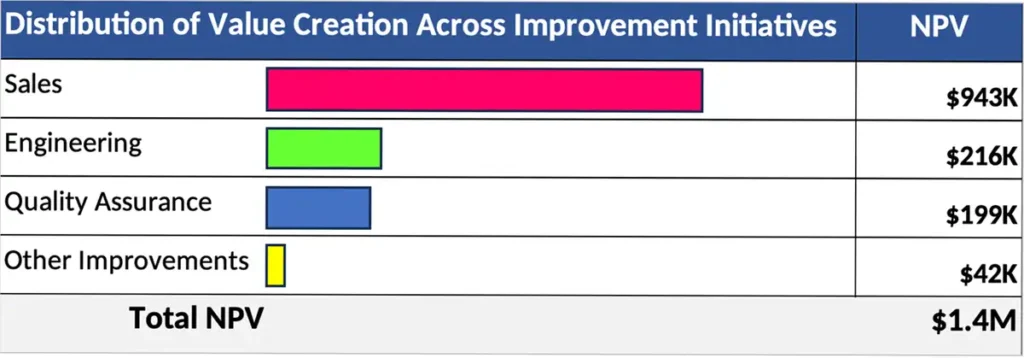
Through a series of targeted Lean Six Sigma initiatives across Sales, Engineering, Quality Assurance, and internal support functions, the organization implemented multiple operational improvements that generated $1.4 million in Net Present Value (NPV).
The financial impact represented:
- 27% of total company payroll
- 126% of the payroll of the employees directly involved in the transformation
These results demonstrate how structured Operational Excellence programs can unlock significant financial value without requiring additional headcount or major capital investments.
Company Context
The client is a specialized manufacturing company operating in a highly technical environment requiring close collaboration between Sales, Engineering, Production, and Quality Assurance.
The organization employs approximately 100 people and maintains an annual payroll of approximately $5 million.
As the company continued to grow, several operational challenges began to emerge:
- increasing complexity in internal processes
- excessive manual coordination between departments
- inefficient workflows consuming engineering capacity
- quality assurance processes with unnecessary movement and variability
- internal support processes creating productivity bottlenecks
To address these challenges, the company partnered with AM Saxum to deploy a structured Operational Excellence program using Lean Six Sigma methodologies.
The transformation was executed over several months through a series of Lean Six Sigma improvement projects led by cross-functional teams.
Transformation Approach
Rather than focusing on isolated improvement projects, the initiative aimed to build internal capability while implementing high-impact operational improvements.
Employees from multiple departments participated in Lean Six Sigma projects, identifying opportunities to streamline processes, reduce inefficiencies, and improve coordination across the organization.
The transformation team consisted of approximately a dozen employees from different functions, including Sales, Engineering, Quality Assurance, and internal support roles.
Each team member worked on a specific improvement project while applying structured Lean Six Sigma problem-solving tools.
Value Creation Overview
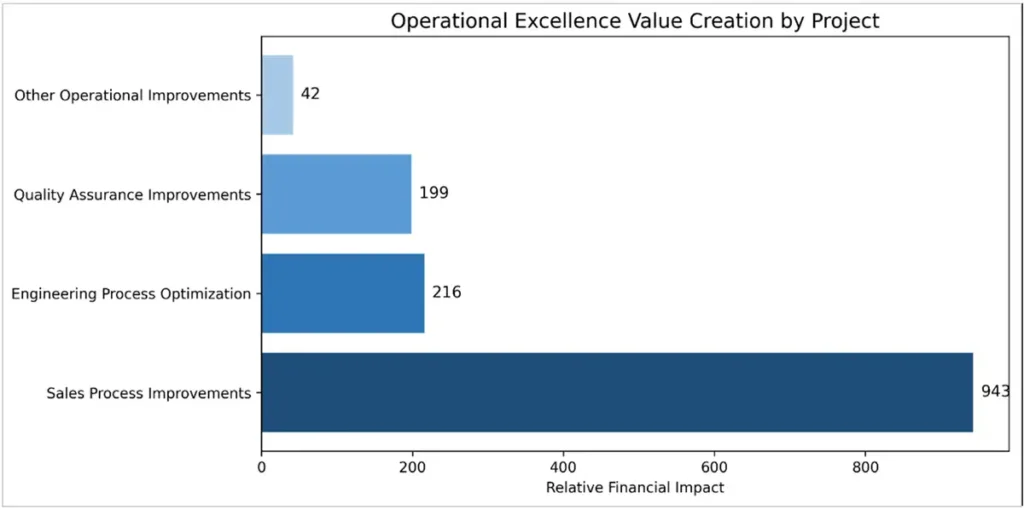
The Operational Excellence program generated $1.4 million in Net Present Value (NPV) through several improvement initiatives grouped into four major transformation areas.
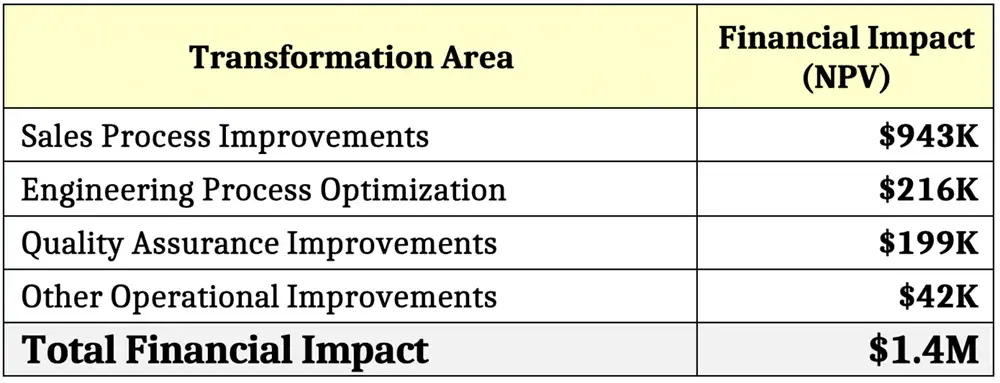
The financial impact was calculated using the Net Present Value (NPV) based on approved annual savings and a discount rate of 7%, approximating the company’s weighted average cost of capital (WACC).
Financial Leverage of the Transformation
Two metrics highlight the financial leverage of the Operational Excellence program.
Impact relative to total company payroll
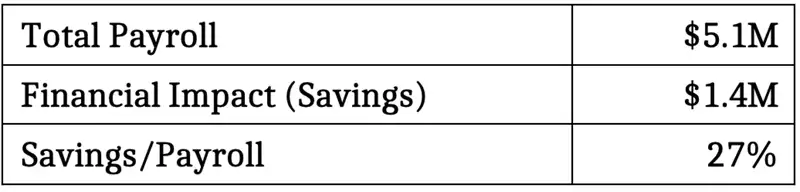
For perspective, the financial impact generated by the Operational Excellence program represented approximately 27% of the company’s total annual payroll, demonstrating the significant leverage that structured operational improvement initiatives can deliver.
Impact relative to transformation team payroll
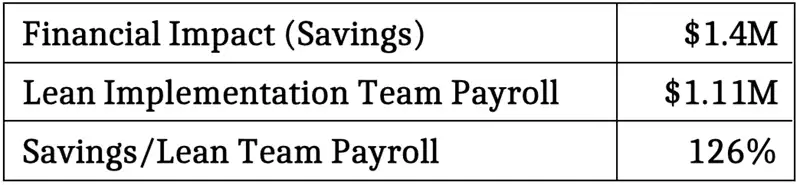
This type of leverage is one of the reasons Operational Excellence programs are often among the highest-return initiatives available to manufacturing organizations.
Sales Process Transformation
Eliminating Inter-Departmental Overprocessing
The largest improvement initiative focused on improving the order-to-shipment process, which required coordination between Sales, Shipping, Accounting, and Supply Chain.
Process mapping revealed multiple sources of inefficiency, including redundant communication, manual data entry, and fragmented visibility of shipment information across departments.
Employees frequently had to request shipment tracking information manually, creating delays and unnecessary interruptions.
The improvement initiative combined Lean process redesign with targeted ERP system enhancements, allowing shipment tracking information to flow more efficiently between departments.
These improvements reduced manual data entry, improved visibility across systems, and streamlined internal communication.
Key benefits included:
- faster order processing
- reduced internal communication overhead
- improved customer responsiveness
- improved data accuracy
This initiative generated $943K in Net Present Value (NPV) and represented the largest contributor to the overall financial impact of the program.
Engineering Process Optimization
Streamlining the Quoting Process
The second major initiative focused on improving the engineering quoting process.
Preparing technical quotations required significant engineering effort, including design work, cost calculations, and coordination between Engineering, Sales, and Costing.
However, internal analysis revealed that only approximately 40% of quotes converted into purchase orders.
This meant that a large portion of engineering capacity was being consumed by quoting activities that did not result in revenue.
A detailed process mapping exercise identified numerous opportunities to streamline the workflow, reduce administrative effort, and improve coordination between Sales and Engineering.
Improvements included:
- standardized quoting workflows
- clearer roles and responsibilities between departments
- improved qualification of requests for quotation
- simplified documentation requirements
These changes reduced the time required to prepare quotes and improved the utilization of engineering resources.
The initiative generated $216K in Net Present Value (NPV).
Quality Assurance Improvements
Improving Efficiency and Process Stability
Three improvement initiatives focused on enhancing quality control processes and testing efficiency.
Although these activities represent a smaller portion of overall operations, inefficiencies in inspection and testing workflows can create delays and unnecessary handling of materials.
Workplace Organization in the Quarantine Area
The first initiative focused on improving the handling of non-conforming materials within the quarantine area.
The analysis revealed excessive movement of rejected components before final disposal.
Using 5S principles, the team reorganized the workspace and standardized procedures for processing scrap materials, reducing unnecessary motion and improving operational discipline.
Inspection Process Improvements
The second initiative addressed inconsistencies in inspection practices that could lead to repeated measurements and uncertainty in quality verification.
Process mapping helped standardize inspection procedures and clarify measurement practices, improving consistency and reducing variability.
Streamlining the Testing Process
The third initiative focused on improving the efficiency of finished products testing procedures.
A detailed workflow analysis identified opportunities to streamline test preparation, improve workstation organization, and standardize testing procedures.
Together, these three initiatives generated $199K in Net Present Value (NPV).
Other Operational Improvements
Reducing Employee Downtime
Additional improvements targeted internal support processes that affected employee productivity.
One initiative focused on improving the efficiency of internal IT services.
The organization’s IT department supported more than 85 employees with only two full-time staff members, making rapid issue resolution critical for maintaining productivity.
Lean analysis identified opportunities to reduce delays in hardware and software deployments.
Improvements included:
- standardized workstation configurations
- pre-configured replacement systems
- improved inventory management of IT components using Kanban principles
- standardized software deployment procedures
These changes reduced resolution times for IT issues and minimized employee downtime.
The initiative generated $42K in Net Present Value (NPV).
Key Lessons from the Transformation
Several important insights emerged from the Operational Excellence program:
Cross-department processes often contain the largest inefficiencies
Many improvements occurred at the intersection of departments rather than within a single function.
Engineering capacity is a critical resource
Improving how engineering time is allocated can generate significant financial impact without increasing headcount.
Operational Excellence extends beyond production
Improvements in support functions such as Quality Assurance and IT can generate meaningful productivity gains.
Empowering internal teams accelerates improvement
By involving employees directly in improvement initiatives, the organization strengthened internal capability while delivering measurable financial results.
Why AM Saxum
AM Saxum helps organizations unlock financial value through Operational Excellence, Lean Six Sigma methodologies, and leadership capability development.
Across multiple industries, AM Saxum’s consultants have delivered over $500 million in measurable financial impact by helping organizations improve processes, strengthen leadership capability, and implement high-impact operational improvements.
Considering an Operational Excellence Transformation?
For executives evaluating how to improve cost structure, operational performance, and long-term competitiveness, a structured Operational Excellence strategy can be a powerful lever.
To learn more about AM Saxum’s Operational Excellence, Lean Six Sigma, and Lean Leadership advisory services, or to discuss your organization’s specific priorities, you may contact AM Saxum at 1-888-772-2809 or reach out through our contact page.
This case study describes a transformation conducted within a mid-size manufacturing organization. Certain details have been generalized to protect client confidentiality.