Executive Summary
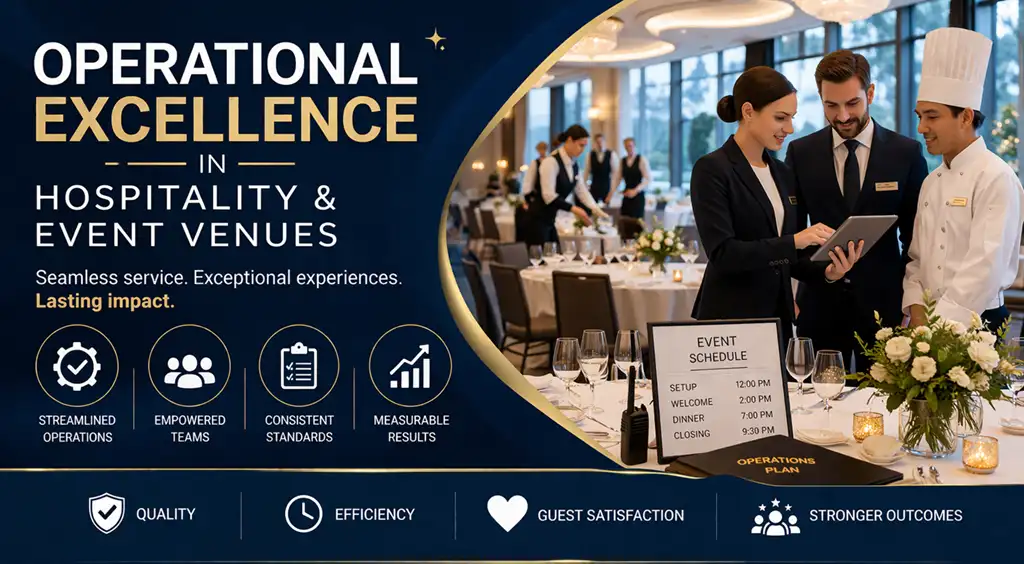
Hospitality organizations often operate in highly dynamic environments characterized by fluctuating demand, seasonal labor, and complex service delivery processes. While Lean Six Sigma methodologies are traditionally associated with manufacturing, service organizations frequently contain significant opportunities for operational improvement.
A multi-year Operational Excellence program led by AM Saxum across multiple hospitality and event venues demonstrates how structured process improvement can unlock substantial financial value.
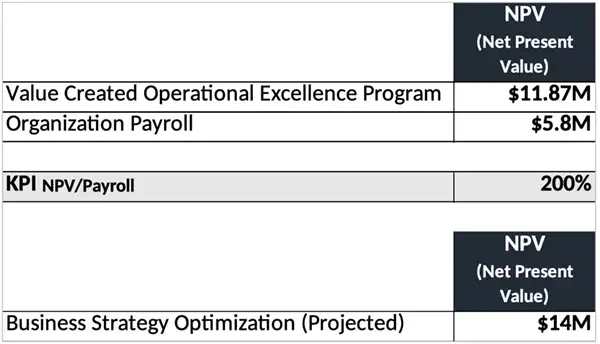
The program implemented Lean Six Sigma across hotel operations, retail fulfillment, and event venue management. Completed initiatives generated $11.87 million in verified Net Present Value (NPV) through operational improvements, productivity gains, and service process optimization.
With a total annual payroll of approximately $5.8 million, the transformation created financial value equivalent to about 200% of annual payroll.
In addition, a strategic transformation initiative currently underway is projected to generate an additional $14 million in gross profit NPV over five years.
Operational Complexity in Hospitality Operations
Hospitality and event-driven businesses face unique operational challenges. Service quality must remain consistently high while operations handle variable demand, customized client requirements, and tight scheduling constraints. While Lean methodologies are traditionally associated with manufacturing, hospitality operations often contain even greater opportunities for improvement due to the labor-intensive nature of service delivery.
Typical operational challenges include:
- Labor-intensive service delivery
- Complex coordination between front-of-house and back-of-house teams
- Seasonal demand peaks
- Manual administrative processes
- High customer expectations regarding service quality
These characteristics create environments where operational inefficiencies can remain hidden within daily activities.
Applying Lean Six Sigma principles to service environments allows organizations to identify inefficiencies, redesign workflows, and improve both operational performance and customer experience.
Client Overview
The organization involved in this case operates multiple hospitality and event venues.
These venues host a wide range of corporate and social events while supporting catering services and retail fulfillment operations.
Services include:
- Hotel and event venue operations
- Catering services
- Corporate and social events
- Retail gift basket production and fulfillment
Across its business units, the organization employs 211 employees, including both full-time staff and seasonal personnel who support event operations during peak periods.
Recognizing the need to improve operational efficiency while maintaining service quality, leadership engaged AM Saxum to implement a structured Operational Excellence program using Lean Six Sigma methodology.
Operational Excellence Program Design
The transformation program was structured as a multi-year initiative focused on continuous improvement across multiple operational areas.
Key elements of the program included:
- Lean Six Sigma project execution
- Cross-functional improvement teams
- Process mapping and root-cause analysis
- Operational data analysis
- Financial validation of improvements
- Leadership coaching and capability development
Improvement initiatives were implemented across several business units, with projects typically lasting between six and twenty-four months.
Transformation Across Operational Segments
For confidentiality reasons, the initiatives are grouped into three operational segments.
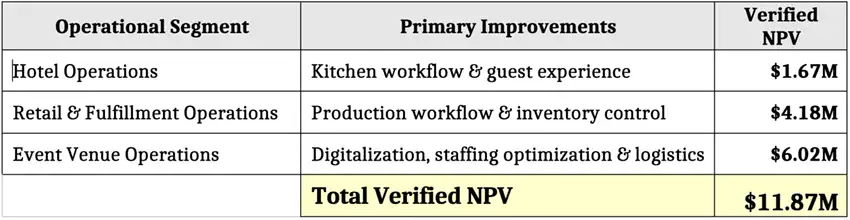
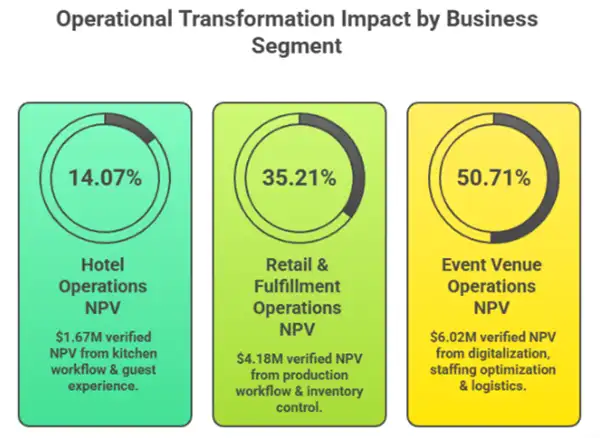
These results were achieved through multiple Lean initiatives addressing operational efficiency, digitalization, customer experience, and workplace organization.
Selected Operational Excellence Initiatives
Increasing Operational Capacity in Hotel Service
One venue experienced operational constraints in kitchen operations due to inefficient layout and equipment placement. The kitchen workflow limited throughput and prevented the operation from reaching full capacity during peak service periods.
Lean analysis revealed unnecessary staff movement and equipment placement that restricted production flow.
The improvement initiative focused on redesigning the kitchen layout, optimizing workstation placement, and implementing targeted equipment upgrades.
These changes increased operational capacity from approximately 60% to 90%, improving service performance and reducing operational pressure during large events.
Improving Online Reputation to Increase Event Bookings
In hospitality, online reviews significantly influence customer purchasing decisions.
Operational analysis revealed that only 27% of clients were leaving online reviews, limiting the venue’s digital visibility and potential customer engagement.
AM Saxum worked with the sales team to integrate a structured review generation process into the customer journey. Review requests were incorporated into post-event communications, and staff were trained to encourage satisfied clients to leave feedback.
The initiative increased review participation while strengthening the venue’s digital reputation and online presence.
Reducing Fulfillment Errors in Gift Basket Assembly
Within the organization’s retail operations, gift baskets are assembled and shipped to corporate and individual customers.
Analysis identified a recurring issue: baskets frequently remained unfinished because items were either missing or present in the warehouse but overlooked during assembly.
This issue occurred in approximately 60% of production cases, particularly during peak holiday periods. In many situations, baskets were delayed because missing items were only discovered at the final stages of preparation.
Lean Six Sigma analysis identified gaps in inventory verification and communication between receiving and assembly teams.
The improvement initiative introduced standardized assembly checklists and item verification procedures integrated into receiving operations.
These improvements reduced fulfillment errors and improved on-time delivery performance.
Digitalizing Event Quoting Processes
Another improvement initiative focused on administrative processes supporting event sales.
Preparing quotes for event clients required significant manual effort, including collecting information from multiple teams and manually compiling proposals.
This manual process created delays and administrative inefficiencies.
AM Saxum redesigned the workflow and introduced CRM-based automation to streamline information gathering and quote preparation.
Automation significantly reduced administrative workload and improved response time for client inquiries.
Improving Workplace Organization Through Lean 5S
Operational inefficiencies were also identified in storage and logistics areas supporting event preparation.
One venue’s basement storage area had become overcrowded and disorganized, making it difficult for staff to locate equipment required for event setup.
Lean analysis showed that storage congestion increased transportation time and slowed setup operations.
The improvement initiative implemented a Lean 5S workplace organization program, reorganizing storage areas and relocating selected materials to an external container at ground level.
This change improved accessibility, reduced transportation time for staff, and allowed more efficient purchasing of non-perishable supplies.
Strategic Business Model Transformation
Beyond operational improvements, AM Saxum worked with leadership to redesign the product portfolio of the organization’s retail operations. The large number of product variations created operational complexity, increased inventory management effort, and reduced purchasing leverage with suppliers.
Over time, the product catalog had expanded to several hundred basket configurations. While this variety appeared attractive from a marketing perspective, it created operational complexity, inventory management challenges, and lower purchasing leverage with suppliers.
AM Saxum recommended a portfolio simplification strategy that reduced the number of product configurations while introducing two clearly defined market segments:
- Luxury product line
- Economy product line
This strategy improved production efficiency, simplified inventory management, and expanded market reach.
The initiative is currently underway and is projected to generate approximately $14 million in additional gross profit NPV over five years.
Financial Impact
The Lean transformation generated $11.87M in verified financial impact, equivalent to more than 200% of the organization’s annual payroll. The financial impact was generated through multiple Lean Six Sigma initiatives implemented across hotel operations, retail fulfillment, and event venue management.
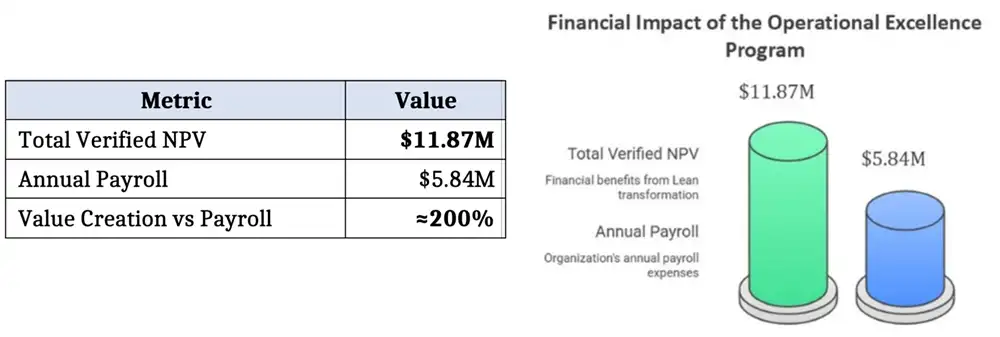
This result highlights the magnitude of operational inefficiencies that can exist in service organizations and the significant value that structured Operational Excellence programs can unlock. These improvements were achieved while maintaining service quality and enhancing the customer experience.
Key Lessons for Service Organizations
This transformation highlights several important lessons for hospitality and service organizations.
- Operational Excellence applies beyond manufacturing. Service environments often contain significant opportunities for process improvement.
- Operational complexity increases with product and service variety. Strategic simplification can improve efficiency and scalability.
- Digitalization and process improvement are complementary. Automating administrative processes can significantly improve productivity.
- Workplace organization matters in service environments. Lean tools such as 5S can improve efficiency even in non-manufacturing operations.
About AM Saxum
AM Saxum is a management consulting firm specializing in Operational Excellence, Lean Six Sigma implementation, and leadership development for organizations seeking measurable performance improvement.
The firm supports organizations in improving operational performance, strengthening leadership capability, and delivering measurable financial results.
AM Saxum consultants have helped organizations achieve over $500 million in financial impact through structured Operational Excellence initiatives across multiple industries.
Considering an Operational Excellence Transformation?
If your organization is exploring ways to improve operational performance, reduce operational inefficiencies, and strengthen long-term competitiveness, AM Saxum would welcome the opportunity to discuss how Operational Excellence can support your objectives.
To learn more about AM Saxum’s Operational Excellence, Lean Six Sigma, and Lean Leadership advisory services, please contact us at 1-888-772-2809 or connect with our team through our through our contact page:
This case study describes a transformation conducted within a hospitality organization. Certain details have been generalized to protect client confidentiality.