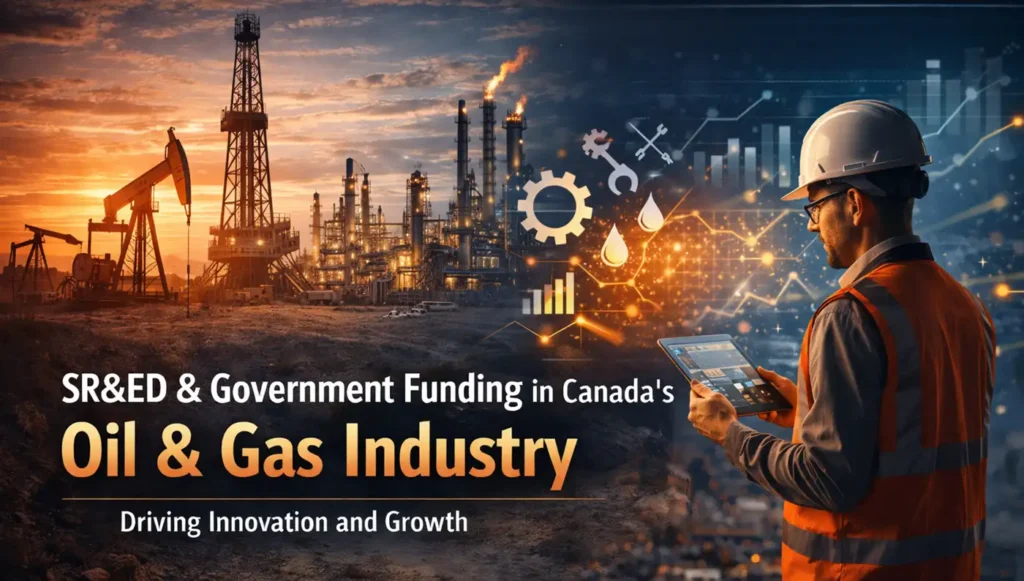
Canada’s Oil & Gas sector remains one of the most technologically complex and capital‑intensive industries in the country. Companies operating across exploration, drilling, production, and energy infrastructure face constant pressure to improve efficiency, reduce environmental impact, and operate in increasingly challenging geological and operating environments.
Within this context, SR&ED & government funding in the Oil & Gas industry can serve as a strategic financial instrument that helps organizations support innovation while protecting cash flow. While major operators often dominate industry headlines, a significant portion of technological advancement occurs across the broader ecosystem of equipment manufacturers, oilfield service providers, engineering firms, and specialized technology developers.
For executive teams responsible for capital allocation and financial performance, understanding how SR&ED and related Canadian innovation funding programs operate can unlock meaningful financial support for innovation initiatives already underway within their organizations.
Industry Innovation Context & Financial Pressure
The Oil & Gas industry faces continuous technological pressure driven by complex geological conditions, volatile commodity prices, and evolving environmental expectations. Companies must consistently improve extraction techniques, drilling efficiency, and processing technologies to remain competitive.
At the same time, firms across the supply chain must engineer equipment capable of operating in extreme conditions involving high pressure, temperature, corrosion, and remote environments. These challenges frequently require engineering experimentation and iterative development.
Regulatory expectations and environmental considerations also drive technological development. Many companies are investing in innovations designed to reduce emissions, improve water management, and increase energy efficiency.
These innovation efforts frequently involve technological uncertainty. Engineers and technical teams conduct systematic experimentation to test new materials, equipment designs, and operational methods.
Government funding programs in Canada—including the SR&ED tax credit Canada—exist specifically to support these types of innovation activities. When strategically integrated into financial planning, these programs can significantly reduce the effective cost of research and development.
Understanding SR&ED as a Strategic Financial Instrument
The Scientific Research and Experimental Development (SR&ED) program is Canada’s primary R&D tax incentive designed to encourage technological innovation.
At a high level, SR&ED supports work performed to achieve scientific or technological advancement through systematic experimentation. In the Oil & Gas sector, this may include developing improved drilling technologies, optimizing reservoir recovery techniques, designing high‑performance equipment, or advancing monitoring and automation systems used across energy operations.
Eligible expenditures under the SR&ED program typically include technical labour, materials consumed during experimentation, and specialized subcontractor work related to development activities. Depending on the organization’s tax profile, these expenditures may generate refundable or non‑refundable tax credits.
From a financial perspective, SR&ED should not be viewed simply as a tax benefit. Instead, it functions as a strategic reinvestment mechanism that helps organizations mitigate innovation risk and continue investing in technological advancement.
Examples of SR&ED‑Eligible Projects in the Oil & Gas Industry
Innovation occurs across multiple tiers of the Oil & Gas ecosystem—from major operators to equipment manufacturers and engineering firms. Examples of development activities that may qualify for SR&ED include:
- Experimentation aimed at improving drilling efficiency in complex geological formations.
- Development of new downhole tools or sensor technologies designed to enhance reservoir monitoring.
- Engineering experimentation to improve the durability of pumps, valves, or pipeline components operating in high‑pressure environments.
- Development of improved hydrocarbon separation or processing technologies.
- Testing advanced automation or monitoring systems designed to improve reliability of energy infrastructure.
- Development of materials or coatings designed to extend equipment life in corrosive or abrasive environments.
Eligibility ultimately depends on the presence of technological uncertainty and a systematic experimentation process designed to resolve that uncertainty.
Beyond SR&ED: The Broader Government Funding Landscape
While SR&ED represents the foundation of Canada’s innovation support system, organizations in the Oil & Gas sector may also benefit from complementary government funding programs.
Federal and provincial initiatives may support investments in advanced manufacturing equipment, clean technology adoption, workforce development, and energy innovation initiatives. These programs can complement SR&ED by supporting capital investment and technology deployment.
For companies investing in new processing technologies, equipment development, or emissions reduction initiatives, combining multiple funding programs can strengthen the financial viability of innovation projects.
Maximizing SR&ED Value While Ensuring Technical Robustness
Capturing the full value of the SR&ED program requires disciplined preparation and strong technical documentation.
Effective claims often involve:
- Clearly defining the technological uncertainties addressed by development projects.
- Implementing structured documentation practices that capture experimentation activities throughout the year.
- Establishing cost tracking systems capable of identifying eligible labour, materials, and subcontractor expenditures.
- Identifying development work occurring across multiple facilities or departments.
- Preparing technically robust narratives aligned with CRA expectations.
When implemented properly, SR&ED becomes a repeatable financial strategy that supports long‑term innovation.
Financial Impact & Strategic Value
Innovation in the Oil & Gas sector frequently requires significant investment before commercial outcomes are achieved.
SR&ED incentives help reduce the effective cost of these innovation activities. By recovering a portion of development expenditures, companies can strengthen short‑term cash flow while continuing to invest in critical technology initiatives.
From a financial perspective, this can improve EBITDA performance, enhance return on innovation investment, and strengthen competitive positioning.
Why AM Saxum
AM Saxum provides specialized advisory services supporting Canadian organizations navigating SR&ED and government funding programs.
Our team combines industry specialized expertise with more than 20 years of experience helping organizations capture innovation funding opportunities. With a success rate exceeding 96% for SR&ED and other funding applications, we focus on technically robust claims while minimizing disruption to client operations.
Through a proprietary SR&ED tracking system and a client‑centric methodology, AM Saxum helps organizations identify eligible projects, capture qualifying costs, and strengthen technical narratives.
Over the past two decades, AM Saxum has secured more than $100M in government funding for clients.
Next Steps for Executive Consideration
For Canadian organizations assessing how to better align innovation activities with available government funding programs, a structured SR&ED strategy can provide meaningful financial support while strengthening long‑term competitiveness.
To learn more about AM Saxum’s SR&ED and Government Funding advisory services, or to discuss your organization’s innovation and funding priorities, you may contact AM Saxum at 1‑888‑772‑2809 or reach out through our contact page: