Early in my career working in operations, I paid relatively little attention to what are often described as “soft skills,” and I certainly hadn’t considered the link between EBITDA and leadership behavior. Having been trained as an industrial engineer, the concept of company value was still fresh in my mind as it is typically presented in finance textbooks: the value of a business is the present value of its future cash flows.
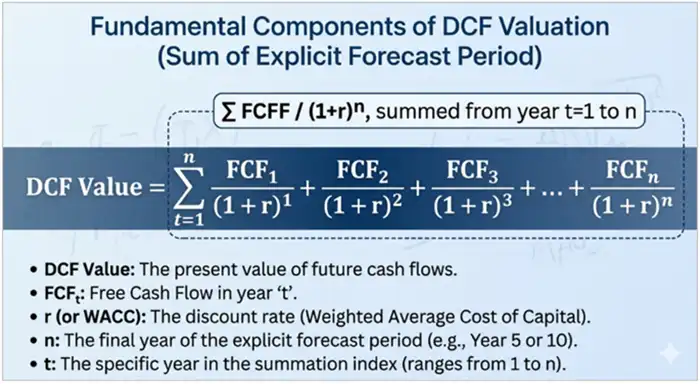
In that framework, performance appears to be driven primarily by variables such as capital investment, technology, automation, and strategic decisions affecting revenue and cost structure. At first glance, this perspective seems entirely logical. If a company can increase revenues or reduce operating costs, its future cash flows improve—and therefore so does its value.
Yet as I gained professional experience, reality proved to be more complex than the models presented in finance books.
In practice, I began to notice that organizations implementing similar operational excellence initiatives—often using the same Lean Six Sigma methodologies—achieved dramatically different results. Some organizations improved rapidly, while others struggled to sustain even modest gains.
This observation gradually led me to shift my attention from the “what” to the “who”.
Technical solutions, methodologies, and improvement frameworks are important. However, the decisive factor in whether these initiatives succeed or fail often lies elsewhere: leadership behavior and the environment leaders create for their teams.
The Conventional Management Mindset
During my consulting practice, I often observe a familiar pattern in how organizations attempt to improve performance. Finance leaders focus on capital allocation and financial structure. Engineers focus on technical solutions and process optimization. Founders and CEOs focus on strategic positioning and market opportunities.
Each of these perspectives is valid and important. However, even when organizations follow these principles correctly, performance frequently ranges from mediocre to disappointing.
Over time, it becomes clear that high‑performing organizations do something additional. Beyond strategy, technology, and capital allocation, they pay close attention to variables that are less visible on financial statements: work environment, employee engagement, and leadership behavior.
Evidence from Research: Leadership and Financial Performance
One of the most frequently cited studies linking leadership culture to financial performance was conducted by Harvard Business School researchers John P. Kotter and James L. Heskett. Their longitudinal study examined 207 large U.S. companies over an eleven‑year period.
The researchers compared organizations with “adaptive cultures”—where leadership encouraged initiative, openness, accountability, and responsiveness—with companies characterized by rigid hierarchies and limited employee empowerment.
The financial results were striking. Over the eleven‑year period, companies with adaptive leadership cultures achieved:
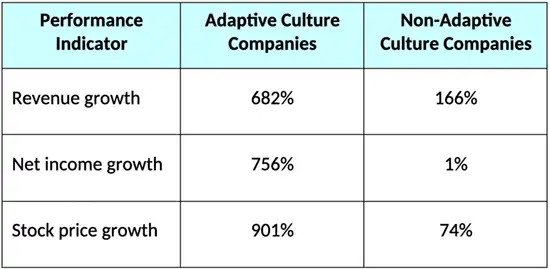
While many factors influence business performance, the study strongly suggested that leadership‑driven culture plays a critical role in determining long‑term financial outcomes.
Team Dynamics and Performance: Insights from Google
A more recent example comes from Google’s well‑known internal research initiative known as Project Aristotle. Conducted between 2012 and 2015, the project sought to answer a simple but important question: why do some teams consistently outperform others, even when they are composed of equally talented individuals?
After studying more than 180 teams, researchers reached a surprising conclusion. The most important factor was not individual intelligence, educational background, or technical expertise. Instead, team dynamics—particularly psychological safety—emerged as the most critical determinant of performance.
Psychological safety refers to an environment where team members feel comfortable raising concerns, admitting mistakes, and proposing ideas without fear of embarrassment or retaliation.
As the researchers concluded: “Who is on the team matters less than how the team members interact.”
In practical terms, this means that leadership behavior shapes the conditions that allow teams to collaborate, expose problems, and improve processes—activities that ultimately influence operational performance.
Addressing the Skepticism: Correlation vs. Causation
At this point, many analytically minded executives raise an important objection: correlation does not necessarily imply causation. Just because leadership culture and financial performance appear related does not prove that one directly causes the other.
This is a valid concern. Business performance is influenced by many variables, including market conditions, industry dynamics, and technological capabilities. However, research in management science has gone beyond simple correlations.
Experimental Evidence: The Bloom Randomized Study
One of the most rigorous experiments in management science was conducted by economist Nicholas Bloom and colleagues and published in the Quarterly Journal of Economics.
The researchers studied 28 textile manufacturing plants in India and randomly divided them into two groups. One group received intensive management consulting aimed at introducing modern management practices, while the control group continued operating normally.
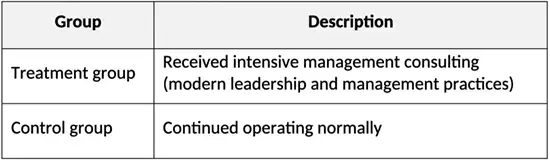
The consulting intervention included practices closely aligned with operational excellence principles:
- Structured daily performance reviews
- Clear accountability for supervisors
- Improved communication between management and frontline workers
- Formal problem‑solving routines
- Data‑driven decision making
After roughly one year, the plants implementing these management practices achieved remarkable improvements. Productivity increased by approximately 17%, defects declined significantly, and inventory management improved. The control group experienced none of these changes.
Because the firms were randomly assigned, the study provides strong evidence that improvements in leadership and management practices can directly influence operational performance and profitability.
What the Evidence Really Shows
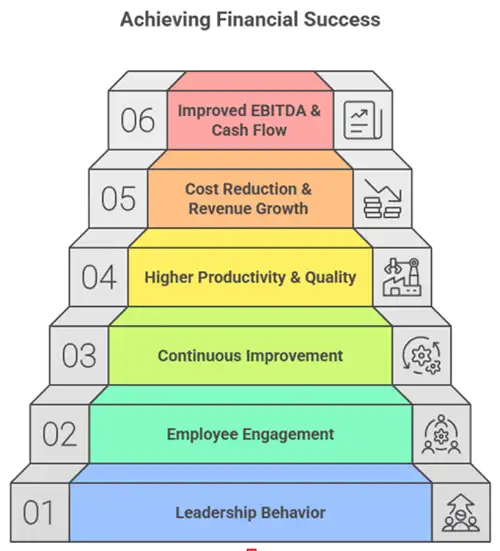
Taken together, these studies suggest a consistent pattern. Leadership behavior influences how employees interact, how problems are identified, and whether improvement initiatives are sustained.
In operational environments, this relationship can often be understood through a simple chain of cause and effect:
What Is Lean Leadership?
Within the context of operational excellence, these leadership behaviors are often described under the concept of Lean Leadership.
At AM Saxum, we define Lean Leadership as the set of leadership behaviors that enable continuous improvement, operational discipline, and measurable financial performance.
While Lean tools focus primarily on processes, Lean Leadership focuses on the behaviors required to enable and sustain those process improvements over time.
A Simple Model of Organizational Effectiveness
One way to illustrate this relationship is through a simple equation frequently used in change management, E = T x P:
(E) Effectiveness of change = (T) Technical Solution × (P) People Engagement
Even when the technical solution is excellent, organizational transformations often fail when engagement is low. Conversely, when leadership creates strong engagement and alignment, teams are far more likely to identify problems, collaborate effectively, and sustain improvement initiatives.
Our Lean Leadership programs focus on strengthening the “P” component of this equation—developing the leadership capabilities required to engage teams and successfully implement operational change.
The AM Saxum Perspective
AM Saxum works with leadership teams to translate Operational Excellence strategies into measurable business outcomes. The firm brings more than twenty years of experience supporting organizations in improving operational performance, strengthening management systems, and delivering sustainable financial results.
Across industries, AM Saxum consultants have helped organizations generate more than $500 million in cost savings through disciplined operational improvement initiatives. By combining deep Lean Six Sigma expertise with practical industry experience, our consultants help leadership teams identify performance constraints and implement improvements aligned with executive priorities.
Rather than focusing on theoretical frameworks, AM Saxum emphasizes execution. Our consultants work directly with leadership and operational teams to stabilize processes, improve performance visibility, and embed sustainable management practices that drive long‑term financial results.
For executives evaluating how to improve cost structure, operational performance, and long‑term competitiveness, a structured Operational Excellence strategy can be a powerful lever.
To learn more about AM Saxum’s Operational Excellence, Lean Six Sigma, and Lean Leadership advisory services, or to discuss your organization’s specific priorities, you may contact AM Saxum at 1‑888‑772‑2809 or reach out through our contact page: