Early mining operations in the 19th century often relied on brute force and scale rather than disciplined operational control. As deposits became more complex and ore grades declined, companies discovered that profitability increasingly depended not on extraction alone, but on how efficiently the entire value chain—from drilling to processing—was managed. Today, that lesson remains central to the economics of the metals and mining industry.
The Metals & Mining Industry: Operational Pressure and Financial Reality
The metals and mining sector operates under some of the most demanding economic and operational conditions in global industry. Commodity price volatility, declining ore grades, capital-intensive infrastructure, and rising energy costs create persistent pressure on margins. Even in favorable commodity cycles, profitability can erode quickly when operational performance fails to keep pace with cost inflation or productivity expectations.
For executives responsible for mining operations, financial performance is heavily influenced by factors that are operational rather than commercial. Production reliability, equipment availability, processing yield, and energy efficiency often determine whether a mining operation remains competitive.
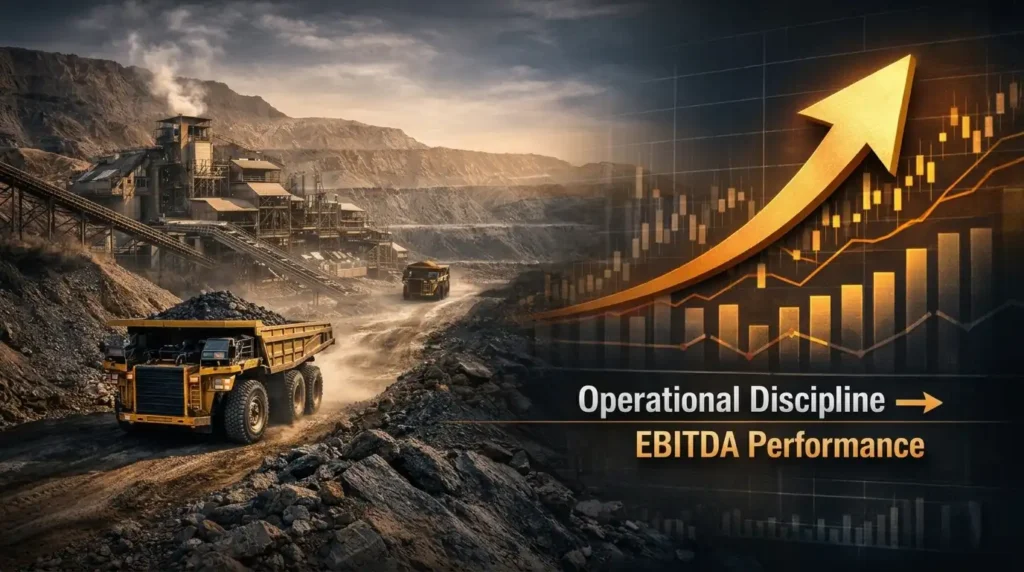
Unlike many other industries, mining companies cannot easily adjust production inputs or relocate operations when market conditions change. Mines are fixed assets with long investment horizons. This makes operational discipline essential for maintaining cost competitiveness and protecting EBITDA across commodity cycles.
Why Operational Excellence Has Become a Strategic Imperative
In this environment, Operational Excellence is no longer simply an operational improvement initiative—it is a strategic requirement for sustaining financial performance.
For mining companies, disciplined operational management directly influences several critical performance dimensions:
– Cost structure resilience during commodity downturns
– Stable production throughput and asset utilization
– Predictable processing yields and recovery rates
– Reduced operational risk and downtime
– Stronger management visibility across complex operations
When operational systems are inconsistent or poorly coordinated, mines frequently experience hidden losses: unplanned downtime, recovery losses, excessive maintenance spending, or inefficient use of labor and energy. Over time, these inefficiencies compound into meaningful erosion of EBITDA.
A structured Operational Excellence strategy allows mining organizations to systematically address these constraints while strengthening the reliability and predictability of their production systems.
Lean Six Sigma as the Engine of Execution
While Operational Excellence defines the strategic objective, Lean Six Sigma provides the disciplined execution system that converts improvement priorities into measurable results.
In mining environments, Lean Six Sigma functions as a structured performance management system that aligns operational teams with financial objectives. Rather than focusing on isolated improvements, it establishes a systematic approach to identifying constraints, reducing variability, and stabilizing processes across the entire production chain.
From drilling and blasting to crushing, milling, and refining, each step of the mining value stream contains opportunities for performance improvement when analyzed through a structured problem‑solving methodology. When leadership teams deploy Lean Six Sigma effectively, operational improvements become repeatable, measurable, and financially meaningful.
Operational Realities that Shape Mining Performance
Mining operations face a unique set of operational realities that significantly influence productivity and cost structure.
Material variability is one of the most fundamental constraints in the industry. Differences in ore grade, mineral composition, and rock hardness can dramatically affect throughput, recovery rates, and energy consumption in processing plants.
Additionally, mining operations rely on large-scale equipment fleets operating in harsh environments. Haul trucks, crushers, conveyors, and processing mills must operate reliably under extreme mechanical stress. Even minor failures in critical equipment can halt production and generate cascading operational losses.
In mining operations, productivity improvements are often driven by better control of equipment fleet utilization, mineral processing performance, and the stability of the overall extraction-to-processing value stream.
Several operational levers consistently influence EBITDA performance in metals and mining operations:
1. Equipment Availability and Reliability
Unplanned downtime in crushers, mills, or haul trucks can severely disrupt production schedules. Improving equipment availability through predictive maintenance and reliability-focused operations often yields significant throughput gains.
2. Ore Recovery and Processing Yield
Small improvements in metallurgical recovery can translate into substantial revenue gains. Optimizing grinding performance, flotation efficiency, and processing conditions directly impacts the amount of valuable metal recovered from each ton of ore.
3. Energy Consumption Efficiency
Energy represents one of the largest cost components in mining operations, particularly in grinding and milling processes. Improving energy efficiency per ton processed can significantly reduce operating costs.
4. Throughput Stability in Processing Plants
Processing plants often operate below theoretical capacity due to bottlenecks, variability, or coordination issues between upstream and downstream processes. Stabilizing throughput improves overall asset productivity.
5. Maintenance Strategy Optimization
Reactive maintenance models frequently lead to excessive repair costs and operational interruptions. Structured maintenance planning improves asset reliability while reducing total lifecycle costs.
6. Supply Chain and Inventory Coordination
Mining operations depend on timely availability of spare parts, reagents, and consumables. Poor coordination often leads to production delays or excess working capital tied up in inventory.
Mining executives typically track performance through key performance indicators such as:
• AISC (All-In Sustaining Cost) per ounce or per ton
• Metallurgical recovery rates in processing plants
• Mill throughput and utilization rates
• Equipment availability and fleet utilization
• Energy consumption per ton processed
Operational Excellence initiatives directly influence these metrics, which ultimately determine the cost competitiveness and financial resilience of mining operations.
Financial Impact and Enterprise Value Creation
For mining companies, the financial impact of Operational Excellence initiatives often extends well beyond traditional cost reduction.
Improvements in equipment reliability, throughput stability, and processing yield can significantly increase production output without requiring additional capital investment. At the same time, reductions in energy consumption, maintenance costs, and operational variability strengthen operating margins.
These improvements translate directly into stronger EBITDA performance, improved free cash flow generation, and better capital efficiency.
In capital-intensive industries such as mining, even modest improvements in operational performance can have a meaningful impact on enterprise value. Higher productivity from existing assets reduces the need for capital expansion while strengthening competitiveness across commodity cycles.
In capital-intensive industries such as metals and mining, operational improvements achieved without major capital investment often generate the highest return on invested capital.
Why AM Saxum
AM Saxum brings more than 20 years of experience helping organizations unlock measurable financial value through Operational Excellence. Across industries, our consultants have helped clients generate over $500 million in cost savings and operational improvements.
Our approach combines structured Lean Six Sigma execution with deep operational and leadership expertise. Rather than focusing on isolated improvement initiatives, we work alongside executive teams to align operational transformation with strategic financial objectives.
AM Saxum’s consultants bring hands-on industry experience and are located across key cities, allowing us to support client organizations directly at their facilities while minimizing travel costs and operational disruption. Our focus remains consistent: delivering sustainable improvements in operational performance that translate directly into financial results.
Next Steps for Executive Consideration
For executives evaluating how to improve cost structure, operational performance, and long-term competitiveness, a structured Operational Excellence strategy can be a powerful lever.
To learn more about AM Saxum’s Operational Excellence, Lean Six Sigma, and Lean Leadership advisory services, or to discuss your organization’s specific priorities, you may contact AM Saxum at 1-888-772-2809 or reach out through our contact page.