Executive Industry Context & Financial Pressure
The Plastics & Moldmaking industry operates within a demanding and increasingly complex operating environment. Companies must manage high capital intensity, tight customer specifications, and ongoing cost pressure while maintaining flexibility across a wide range of products, materials, and production volumes. Companies often invest significant upfront capital in tooling, mold design, automation, and auxiliary equipment long before they realize stable returns.alized.
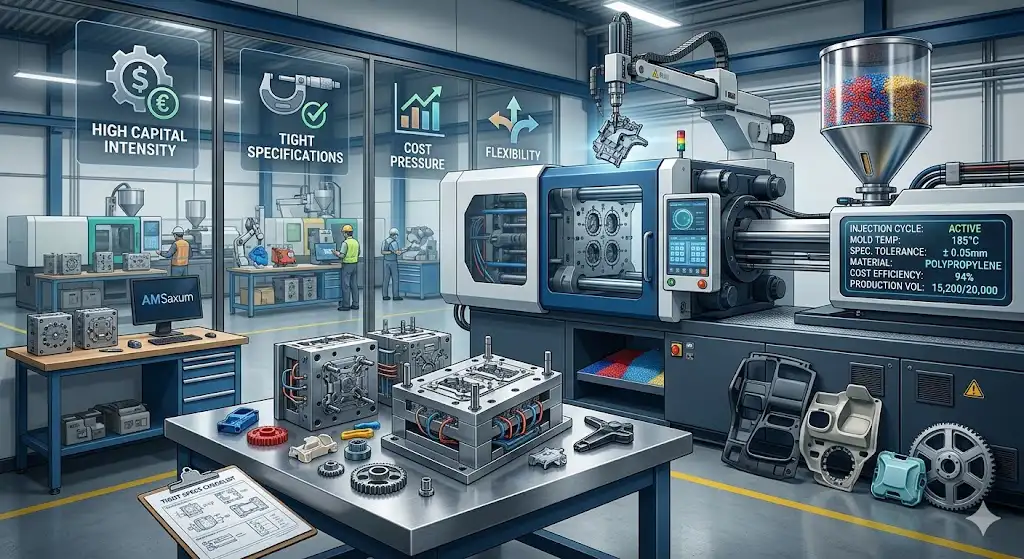
Multiple reinforcing forces drive margin compression. Customers expect continuous cost reductions alongside higher quality and shorter lead times. Resin price volatility, increasing sustainability requirements, and persistent labour constraints add further strain to operating models. At the same time, supply chain disruptions and demand variability expose weaknesses in planning, scheduling, and execution.
In this context, operational inconsistency becomes expensive. Scrap, rework, extended changeovers, and unplanned downtime quietly erode profitability and absorb management attention. For plastics processors and moldmakers, Operational Excellence has become a strategic necessity for protecting margins and sustaining competitive performance.
Why Operational Excellence Is a Strategic Imperative in This Industry
Tightly interconnected systems make Operational Excellence particularly critical in Plastics & Moldmaking. Tooling design, material behavior, process control, and workforce capability are deeply interdependent, and variability in one area quickly cascades across cost, quality, and delivery.
Without a disciplined operating model, organizations often rely on reactive problem solving to address symptoms such as quality escapes, missed shipments, or overtime spikes. While these responses may stabilize short-term performance, they do little to address the underlying drivers of inefficiency.
A structured Operational Excellence approach enables leadership teams to move from firefighting to control. It establishes clear performance expectations, improves visibility into operational drivers, and creates a repeatable mechanism for stabilizing complex production environments while preserving the flexibility required by the market.
How Lean Six Sigma Enables Disciplined Execution
Lean Six Sigma provides the execution backbone that translates strategic objectives into measurable operational outcomes. In Plastics & Moldmaking environments, it functions as a performance management framework rather than a collection of isolated tools.
By combining data-driven analysis with structured problem solving and KPI governance, Lean Six Sigma enables organizations to identify the true sources of variability, prioritize improvement initiatives based on financial impact, and sustain gains over time. Importantly, it aligns engineering, operations, quality, and finance around a shared fact base and common performance objectives.
When embedded effectively, this execution discipline supports consistent decision-making and reduces reliance on individual expertise or ad hoc interventions.
Operational Realities in Plastics & Moldmaking and the Levers That Drive Performance
Performance in Plastics & Moldmaking is constrained by a set of operational realities that are often underestimated at the executive level. High product mix, frequent engineering changes, and diverse material requirements introduce complexity that directly affects cost and reliability.
Key levers that materially influence performance and EBITDA in this industry include:
- Tooling and mold performance stability, where variation in design, maintenance, or wear directly affects cycle time, quality, and scrap.
- Material behavior and shrinkage management, particularly when operating across multiple resin families or incorporating recycled content, creating uncertainty in dimensional consistency.
- Changeover and startup discipline, where insufficient process validation leads to excessive scrap, lost capacity, and quality risk.
- Process window definition and adherence, ensuring operating parameters are established, controlled, and respected under production pressure.
- Cross-functional coordination between engineering, production, and quality, which is essential to prevent recurring issues from being treated as isolated events.
Addressing these levers requires a system-level approach that aligns technical understanding with disciplined execution and leadership accountability.
Financial Impact & Enterprise Value Creation
When Operational Excellence initiatives are executed with rigor, the financial impact is significant and durable. Reductions in scrap, rework, and overtime translate directly into lower operating costs and improved margin performance. Stabilized processes improve throughput reliability, allowing organizations to absorb volume variability without proportional increases in fixed cost.
From a financial perspective, these improvements strengthen free cash flow, reduce working capital tied up in work-in-process and buffer inventory, and improve forecast accuracy. Over time, a more resilient operating model supports sustained EBITDA expansion and enhances enterprise value.
For organizations pursuing growth, ownership transitions, or long-term value creation, operational stability becomes a critical differentiator.
Why AM Saxum
AM Saxum partners with Plastics & Moldmaking organizations as a strategic Operational Excellence advisor focused on measurable value creation. With more than 20 years of experience supporting complex manufacturing environments, our team understands the technical and financial dynamics that define performance in this industry.
Having delivered over $500 million in cost savings across sectors, AM Saxum combines industry-specialized expertise with a pragmatic, execution-oriented approach. Our consultants work alongside leadership teams to design and implement improvement strategies that deliver sustainable results while minimizing disruption to ongoing operations.
Our proximity to client teams and hands-on engagement model ensure accountability, momentum, and lasting impact.
Next Steps for Executive Consideration
For executives evaluating how to improve cost structure, operational performance, and long-term competitiveness in Plastics & Moldmaking, a structured Operational Excellence strategy can be a powerful lever.
To learn more about AM Saxum’s Operational Excellence, Lean Six Sigma, and Lean Leadership advisory services, or to discuss your organization’s specific priorities, you may contact AM Saxum at 1-888-772-2809 or reach out through our contact page: